
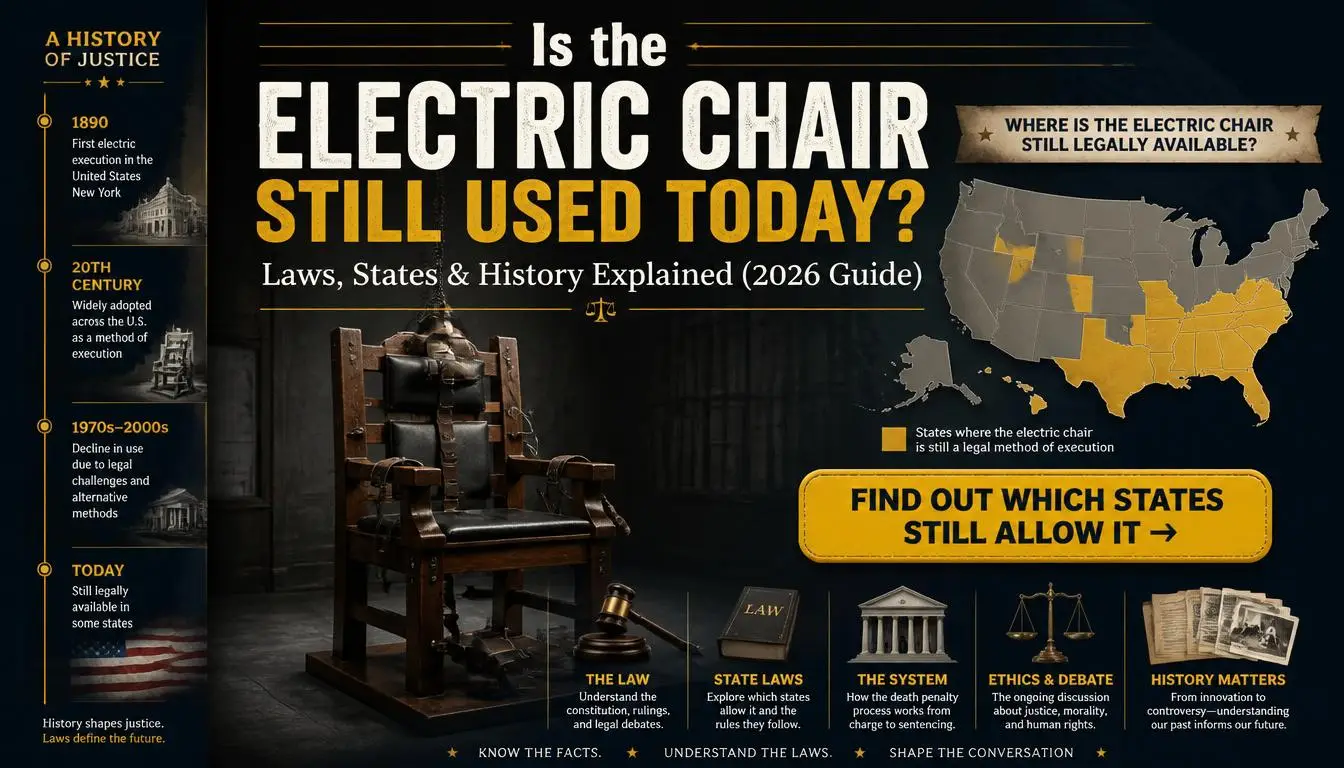
Yes, the electric chair is still legal in a small number of U.S. states, but it is rarely used today. Lethal injection has become the primary execution method across most states, while the electric chair is generally reserved as an optional or backup method under specific legal circumstances.
If you’re wondering whether the electric chair is still used, which states still allow it, why it was replaced, and how the law has changed over time, this guide explains everything in clear, accurate, and easy-to-understand language.
Is the Electric Chair Still Used Today?
The short answer is yes—but only in limited situations.
The electric chair has not completely disappeared from the American legal system. A handful of states still authorize electrocution, but it is no longer the standard method of execution. Today, lethal injection is the primary execution method in most death penalty states, while the electric chair is usually available only as:
- An inmate’s voluntary choice
- A backup method if lethal injection cannot legally or practically be carried out
- A method required under certain state laws in limited situations
Because of legal challenges, changing public opinion, medical ethics, and the adoption of newer execution methods, executions by electric chair have become extremely rare.
For most people searching this topic, the important point is simple: the electric chair still exists in American law, but it is no longer commonly used.
Quick Facts About the Electric Chair
| Question | Answer |
|---|---|
| Is the electric chair still used? | Yes, but only in a few U.S. states and under limited circumstances. |
| Is it the primary execution method? | No. Lethal injection is the primary method in most states with the death penalty. |
| Can inmates choose it? | In some states, yes. |
| Is it legal today? | Yes, in certain states where state law still permits it. |
| Is it commonly used? | No. It is one of the least frequently used execution methods today. |
| Has it been replaced? | Largely yes, by lethal injection and, in some places, other authorized methods. |
Is the Electric Chair Legal Today?
Yes. The electric chair remains legal in several U.S. states, although the rules vary from one state to another.
Some states list electrocution as an optional execution method, allowing eligible death row inmates to choose it instead of lethal injection. Other states keep it as a backup method, meaning it may only be used if lethal injection is unavailable or ruled unconstitutional by a court.
Many other states have abolished the electric chair entirely after adopting different execution methods or ending capital punishment altogether.
This means the answer depends on where the sentence is carried out. There is no single nationwide rule because execution laws are largely determined at the state level.
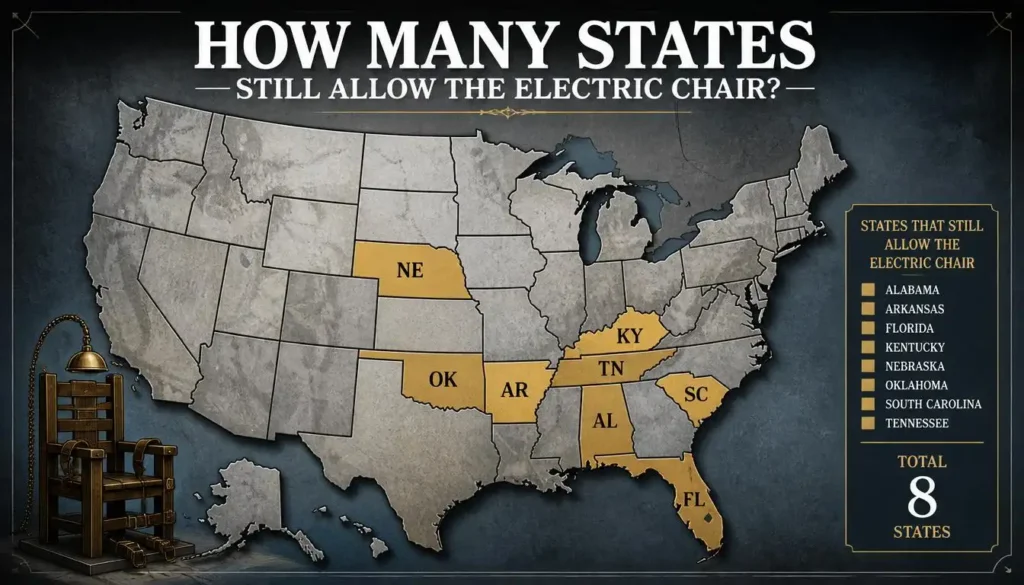
How Many States Still Allow the Electric Chair?
Only a small number of states still authorize electrocution in some form.
Although the exact legal framework differs by state, the electric chair generally falls into one of these categories:
- Optional at the inmate’s request
- Backup method if lethal injection cannot be used
- Authorized under specific legal conditions
Compared with previous decades, the number of states actively relying on the electric chair has dropped dramatically. During much of the twentieth century, it was one of America’s most common execution methods. Today, it is considered an exception rather than the rule.
Which U.S. States Still Allow the Electric Chair?
The following table provides a general overview of states where electrocution continues to have a legal role.
| State | Electric Chair Legal? | Typical Status |
|---|---|---|
| Alabama | Yes | Optional in certain cases |
| Arkansas | Yes (limited circumstances) | Authorized under specific legal conditions |
| Florida | Yes | Optional upon inmate request |
| Kentucky | Yes (limited cases) | Applies under certain legal conditions |
| Mississippi | Yes | Optional or backup method |
| Oklahoma | Yes | Backup method if necessary |
| South Carolina | Yes | Authorized under current state law |
| Tennessee | Yes | Optional under state law |
Important: State execution laws can change through legislation or court decisions. Always check the most recent official state laws when researching current legal status.
States That Have Abolished the Electric Chair
Most U.S. states no longer authorize electrocution.
Some abolished the electric chair after adopting lethal injection, while others eliminated capital punishment altogether. In many places, lawmakers concluded that newer execution methods better reflected evolving legal standards and public expectations.
Common reasons states abandoned the electric chair include:
- Adoption of lethal injection as the preferred method
- Constitutional concerns regarding cruel and unusual punishment
- Court rulings
- Legislative reforms
- Changing public opinion
- Human rights debates
- Advances in medical and legal standards
Today, electrocution survives in only a small portion of the United States.
Why Do Some States Still Keep the Electric Chair?
Many people assume that if the electric chair is rarely used, it must no longer serve any legal purpose. In reality, some states continue to keep it for practical and legal reasons.
1. Backup Execution Method
If lethal injection drugs become unavailable because of shortages, manufacturing restrictions, or legal disputes, state law may authorize another execution method.
2. Inmate Choice
Several states allow eligible inmates to choose electrocution instead of lethal injection.
3. Existing State Laws
Some death penalty statutes still include electrocution because lawmakers have chosen not to remove it.
4. Court Decisions
Legal challenges sometimes affect one execution method but not another. Keeping multiple authorized methods gives states additional legal flexibility.
Is Anyone Executed by Electric Chair Today?
Executions by electric chair still occur, but they are extremely uncommon.
In recent years, only a small number of executions have been carried out using electrocution. Most executions in the United States now use lethal injection or another legally authorized method.
When an electric chair execution does occur, it usually attracts national attention because of its rarity and the ongoing public debate surrounding capital punishment.
For this reason, many younger Americans have never seen the electric chair used during their lifetime, even though it remains legal in a handful of states.
When Was the Last Electric Chair Execution?
The electric chair has been used only occasionally in recent years.
Whenever an execution by electrocution takes place, it often becomes national news because such cases are far less common than they were decades ago. The decline reflects changing execution policies rather than the complete disappearance of the method.
The most recent cases have generally occurred in states where electrocution remains legally authorized and where the inmate either selected it or state law allowed its use under specific circumstances.
As execution laws continue to evolve, the electric chair is expected to remain a rare exception rather than a common practice.
Why Was the Electric Chair Replaced?
For much of the twentieth century, the electric chair was one of the most widely used execution methods in the United States. Over time, however, states began replacing it with other methods, particularly lethal injection.
The change did not happen overnight. Instead, it resulted from decades of legal challenges, technological changes, public debate, and evolving standards for carrying out capital punishment.
Below are the main reasons why the electric chair gradually fell out of regular use.
1. Lethal Injection Became the Preferred Method
Beginning in the late twentieth century, many states adopted lethal injection as their primary execution method. Legislators viewed it as a more modern approach and updated state laws accordingly.
As more states revised their execution statutes, the electric chair became a secondary or optional method rather than the default choice.
2. Constitutional Challenges
The U.S. Constitution prohibits “cruel and unusual punishments” under the Eighth Amendment.
Over the years, inmates and attorneys challenged electrocution in court, arguing that it violated this constitutional protection. While courts have reached different conclusions depending on the circumstances and the state involved, these legal challenges encouraged many states to reconsider their execution laws.
3. Changing Public Opinion
Public attitudes toward capital punishment have changed over the decades.
Although support for the death penalty still exists in parts of the United States, many people questioned whether electrocution remained an appropriate execution method in modern society.
These discussions influenced lawmakers, courts, and policymakers across multiple states.
4. Medical and Ethical Concerns
Medical organizations generally discourage healthcare professionals from participating in executions.
At the same time, legal experts, human rights advocates, and policymakers debated whether older execution methods should continue to be used.
These ethical discussions became another factor behind the transition away from electrocution.
5. Legislative Reform
Many state legislatures simply updated their death penalty statutes.
Instead of eliminating capital punishment entirely, lawmakers often replaced electrocution with methods they considered more consistent with current legal standards.
As a result, the electric chair gradually shifted from being America’s primary execution method to an uncommon alternative.
Why Is the Electric Chair Rarely Used Today?
Although the electric chair remains legal in several states, actual executions by electrocution are uncommon.
Several factors explain why.
Lethal Injection Is Usually the Default
Most states that retain capital punishment list lethal injection as the primary execution method.
Because of this, electrocution is used only in limited situations permitted by state law.
State Laws Have Changed
Many states removed electrocution from their statutes altogether.
Others retained it only as:
- An inmate’s voluntary choice
- A backup method
- A legally authorized alternative under specific circumstances
Legal Challenges Continue
Execution laws continue to face court review.
Whenever legal standards change, states may revise their execution procedures or adopt different methods to comply with judicial decisions.
It Has Become Historically Significant Rather Than Common
Today, the electric chair is remembered more as an important part of American legal history than as a method frequently used in modern executions.
Can Death Row Inmates Choose the Electric Chair?
In some states, yes.
Whether an inmate may choose electrocution depends entirely on state law.
Generally, states fall into one of three categories.
States Where Electrocution May Be Chosen
Some states allow eligible inmates to request the electric chair instead of the default execution method.
Eligibility depends on the state’s statutes and any applicable court decisions.
States Where Electrocution Serves as a Backup Method
Some states authorize electrocution only if another legally approved execution method cannot be used.
In these states, electrocution is not normally the first option.
States That Do Not Allow Electrocution
Many states have completely removed electrocution from their execution laws.
If capital punishment exists in those states, another legally authorized method is used instead.
Is the Electric Chair Constitutional?
One of the most frequently asked legal questions is whether the electric chair is constitutional.
The answer is more complex than a simple yes or no.
The Eighth Amendment
The Eighth Amendment to the U.S. Constitution prohibits cruel and unusual punishments.
This constitutional protection has shaped many court cases involving execution methods.
Rather than focusing only on the electric chair, courts often examine whether a particular execution method creates an unconstitutional risk of unnecessary pain or violates established legal standards.
State Court Decisions
Different state courts have reached different conclusions over the years.
Some states have upheld electrocution under their laws.
Others have ruled against it or encouraged lawmakers to adopt different methods.
As a result, execution laws vary across the country.
The Role of the U.S. Supreme Court
The U.S. Supreme Court has reviewed numerous cases involving capital punishment and execution methods.
Although the Court has addressed important constitutional questions, the legality of specific execution methods often depends on state legislation, lower court rulings, and the facts of individual cases.
Because laws continue to evolve, the legal landscape remains subject to change.
History of the Electric Chair
The electric chair occupies an important place in the history of American criminal justice.
Although it is rarely used today, it significantly influenced the development of capital punishment throughout the twentieth century.
The Origins
During the late 1800s, states began searching for an alternative to hanging.
Many officials believed a different execution method could provide greater consistency and reflect advances in science and technology.
This search eventually led to the development of electrocution.
The First Execution
The first execution using the electric chair took place in New York in 1890.
At the time, many government officials viewed the new method as an improvement over hanging.
Following its introduction, additional states gradually adopted electrocution into their criminal justice systems.
Expansion Across the United States
Throughout the early and middle decades of the twentieth century, the electric chair became one of the country’s most common execution methods.
Many states built dedicated execution chambers equipped for electrocution.
For decades, it remained closely associated with capital punishment in America.
The Shift Toward New Methods
Beginning in the late twentieth century, lawmakers started replacing electrocution with lethal injection.
The transition reflected legal developments, policy changes, technological advances, and evolving public opinion.
Although some states retained the electric chair, its use declined sharply.
The Modern Era
Today, the electric chair survives primarily because some state laws continue to authorize it.
Instead of serving as the standard execution method, it now functions as an optional or backup method in only a limited number of jurisdictions.
Its practical use is rare, but its historical importance remains significant.
Timeline of the Electric Chair
| Year | Major Event |
|---|---|
| Late 1800s | States begin exploring alternatives to hanging. |
| 1890 | First execution by electric chair takes place in New York. |
| Early 1900s | More states adopt electrocution as an execution method. |
| Mid-1900s | The electric chair becomes widely used across the United States. |
| Late 1900s | Lethal injection begins replacing electrocution in many states. |
| 2000s–Present | Electrocution becomes rare and remains legal only in selected states under limited circumstances. |
Myth vs. Fact
| Myth | Fact |
|---|---|
| The electric chair has been completely banned in the United States. | False. It remains legal in a small number of states under specific legal conditions. |
| The electric chair is still America’s primary execution method. | False. Lethal injection is the primary method in most states with capital punishment. |
| Every death penalty state still uses the electric chair. | False. Most have adopted different execution methods or no longer authorize electrocution. |
| Federal law requires all states to use the same execution method. | False. States establish their own execution laws, subject to constitutional limits. |
Electric Chair vs. Lethal Injection
Today, lethal injection is the primary execution method in most U.S. states that retain the death penalty. The electric chair, by comparison, has become a secondary option and is used only under limited legal circumstances.
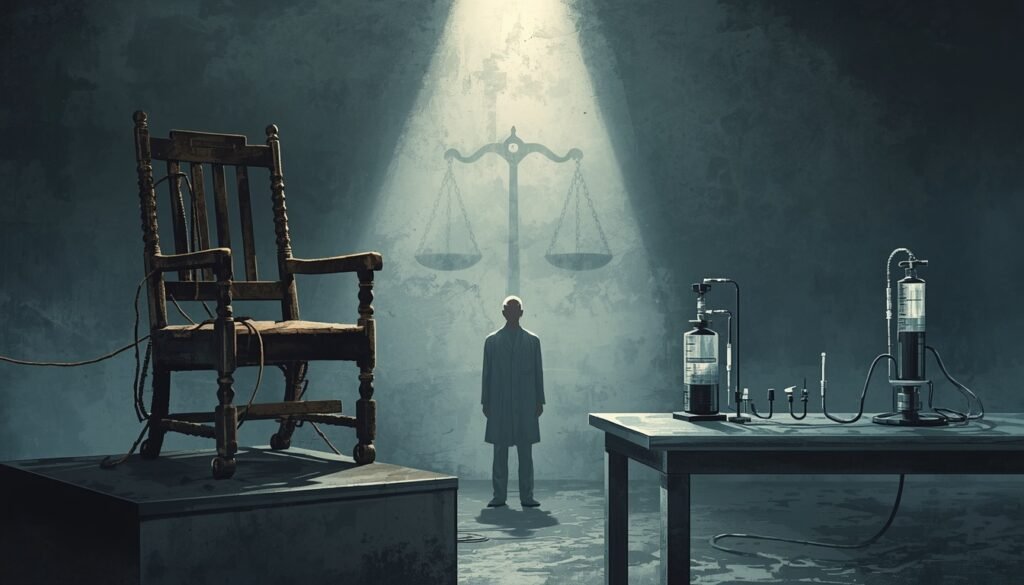
The two methods differ mainly in their legal status, frequency of use, and the way states regulate them.
| Feature | Electric Chair | Lethal Injection |
|---|---|---|
| Primary use today | Rare | Most common execution method in death penalty states |
| Legal status | Authorized in a limited number of states | Primary method in most states with capital punishment |
| Availability | Optional or backup in certain states | Default method in many states |
| Historical significance | Major execution method throughout much of the 20th century | Became widely adopted beginning in the late 20th century |
| Frequency today | Very uncommon | Used far more frequently where capital punishment remains legal |
One reason lethal injection became the preferred method is that many state legislatures updated their execution laws during the 1980s and 1990s. As those legal changes spread across the country, the role of the electric chair steadily declined.
Even so, the electric chair has not disappeared entirely. Some states continue to keep it available because their laws authorize it as an alternative or backup method.
Electric Chair vs. Other Execution Methods
Although the electric chair receives significant public attention, it is only one of several execution methods that have existed in the United States.
Each method has its own legal history, and not every state authorizes the same options.
| Execution Method | Still Used in Some States? | General Status |
|---|---|---|
| Lethal Injection | Yes | Primary execution method in most death penalty states |
| Electric Chair | Yes | Limited legal use in a small number of states |
| Firing Squad | Yes | Authorized in selected states under certain laws |
| Nitrogen Hypoxia | Yes | Recently adopted by some states |
| Gas Chamber | Yes | Rarely authorized and seldom used |
| Hanging | Extremely limited | Largely historical in the United States |
The availability of these methods depends entirely on state law. Some states authorize more than one execution method, while others provide only a single legal option.
Pros and Cons of the Electric Chair
The electric chair has remained one of the most debated execution methods in American history.
Supporters and critics have expressed different views for more than a century.
Arguments Made by Supporters
Supporters generally point to several reasons why some states continue to authorize electrocution.
- It provides an alternative when another execution method cannot legally be used.
- Existing state laws already recognize it as an authorized option.
- Some inmates choose electrocution where state law permits that choice.
- States may view multiple authorized methods as providing additional legal flexibility.
Arguments Made by Critics
Critics raise a variety of legal, ethical, and policy concerns.
Common concerns include:
- Questions about whether older execution methods meet modern constitutional standards.
- Ongoing human rights debates.
- Ethical concerns surrounding capital punishment.
- Continued legal challenges in state and federal courts.
- The belief that execution methods should reflect evolving legal standards.
These differing viewpoints explain why execution policy remains one of the most discussed issues within American criminal justice.
Why the Debate Continues
Even though executions by electric chair are uncommon today, public discussion has not ended.
Several issues continue to shape the debate.
Constitutional Questions
Courts continue to evaluate whether execution methods comply with constitutional protections.
As legal standards evolve, states sometimes revise their execution statutes.
State Independence
Unlike many areas of criminal law, execution methods are largely determined by individual states.
Because each state can adopt different laws, the legal landscape remains complex.
Public Opinion
Public attitudes toward the death penalty have changed over time.
Some people support retaining multiple execution methods, while others favor eliminating capital punishment entirely.
These differing perspectives continue to influence lawmakers and courts.
Interesting Facts About the Electric Chair
The electric chair has a long and fascinating history within the American justice system.
Here are some facts many readers find surprising.
It Was Once the Most Common Execution Method
For decades, electrocution was used more frequently than any other execution method in the United States.
Its widespread adoption reflected the legal standards of the time.
It Has a Famous Nickname
The electric chair is often referred to as “Old Sparky.”
The nickname has been associated with electric chairs used in several different states over the years.
Not Every Electric Chair Was the Same
Although people often imagine a single standard design, different states constructed their execution equipment differently.
Designs and facilities varied depending on local laws and prison systems.
Most Americans Have Never Seen It Used
Because executions by electric chair have become extremely rare, many younger Americans know about it only through history books, documentaries, or news reports.
It Still Appears in State Law
Even though electrocution is uncommon, several states continue to recognize it within their execution statutes.
That legal status is one reason the topic continues to attract public interest.
Common Myths About the Electric Chair
Many misconceptions continue to circulate online.
Understanding the facts helps readers better understand current execution laws.
Myth: The Electric Chair Is Used Regularly
Fact: Electrocution is now one of the least frequently used execution methods in the United States.
Myth: Every Death Penalty State Uses the Electric Chair
Fact: Most states with capital punishment rely primarily on lethal injection, while many no longer authorize electrocution at all.
Myth: The Electric Chair Is Illegal Everywhere
Fact: It remains legal in several states, although its use is limited by state law.
Myth: Every Inmate Can Choose Electrocution
Fact: Whether an inmate may choose the electric chair depends entirely on the laws of the state where the sentence is carried out.
Why This Topic Still Matters Today
Some readers wonder why the electric chair remains an important topic when it is rarely used.
The answer is that it continues to raise significant legal, historical, and constitutional questions.
Studying the electric chair helps explain:
- How execution methods have changed over time.
- Why states adopt different criminal justice policies.
- How constitutional law influences capital punishment.
- Why courts continue reviewing execution-related cases.
- How public opinion affects legislative reform.
For students, researchers, legal professionals, and anyone interested in American history, understanding the electric chair provides valuable insight into the broader evolution of the U.S. criminal justice system.
Expert Perspective
From a historical and legal standpoint, the electric chair represents a major turning point in the evolution of capital punishment.
When it was introduced in the late nineteenth century, many policymakers believed it reflected scientific and technological progress. Over time, however, changing legal standards, ethical discussions, and legislative reforms led most states to adopt different execution methods.
Today, the electric chair serves primarily as a historical reminder of how criminal justice policies can evolve. While it remains legally authorized in a limited number of states, its practical use is uncommon, and its future will likely continue to be shaped by legislative action and court decisions.
Frequently Asked Questions
Is the electric chair still used in 2026?
Yes. The electric chair is still legal in a small number of U.S. states in 2026. However, it is rarely used, and lethal injection remains the primary execution method in most states that retain the death penalty.
Which states still allow the electric chair?
Several states continue to authorize the electric chair under certain legal conditions, including Alabama, Arkansas, Florida, Kentucky, Mississippi, Oklahoma, South Carolina, and Tennessee. State laws can change through legislation or court decisions, so readers should consult official state sources for the most current information.
Is the electric chair still legal today?
Yes. Although many states have abolished electrocution, it remains legal in selected states. In most cases, it serves as an optional or backup execution method rather than the primary one.
Why was the electric chair replaced?
The electric chair was gradually replaced because many states adopted lethal injection as their preferred execution method. Legal challenges, legislative reforms, ethical concerns, and changing public opinion also contributed to the transition.
Why is the electric chair rarely used today?
Electrocution has become uncommon because most states now use lethal injection as the default execution method. In states where the electric chair remains legal, it is typically available only under specific legal circumstances.
Can inmates choose the electric chair?
In some states, yes. Whether an inmate may choose electrocution depends entirely on state law. Some states allow eligible inmates to select it, while others authorize it only as a backup method.
Is the electric chair constitutional?
The constitutionality of execution methods has been the subject of many court cases. While the electric chair remains legal in some states, courts continue to evaluate execution methods under the Eighth Amendment’s prohibition against cruel and unusual punishment.
Which state most recently used the electric chair?
The answer may change as new executions occur or state laws evolve. Because this information is time-sensitive, readers should verify the latest official records and reputable news sources for the most current details.
Is the electric chair more painful than lethal injection?
This question has been debated for decades by courts, lawmakers, medical experts, and legal scholars. Because experiences cannot be objectively measured and the topic remains legally and ethically disputed, there is no universally accepted answer.
Has anyone survived the electric chair?
There have been rare historical incidents in which an execution attempt by electrocution did not immediately proceed as intended. These unusual cases have become part of legal history and have contributed to ongoing discussions about execution methods and constitutional standards.
Why do some states still keep the electric chair?
Some states retain the electric chair as an alternative or backup execution method. Others continue to authorize it because existing state laws have not removed it, or because lawmakers believe multiple legally approved methods should remain available.
Will the electric chair disappear completely?
Its future depends on state legislation, court decisions, and broader public policy debates. Some states may continue to retain it, while others could amend their laws over time. As with many aspects of capital punishment, legal developments continue to shape its future.
Final Verdict
The electric chair remains one of the most recognized symbols in the history of American capital punishment, but its role today is very different from what it was decades ago.
While a limited number of states still authorize electrocution, it is no longer the standard execution method. Lethal injection has largely replaced it, and executions by electric chair have become exceptionally rare.
Understanding the current legal status of the electric chair requires looking beyond a simple yes-or-no answer. Each state has its own laws, courts continue to review constitutional questions, and lawmakers periodically revise execution statutes. As a result, the legal landscape continues to evolve.
For anyone researching capital punishment, the electric chair remains an important topic because it reflects how American criminal justice has changed over time. Its history illustrates the relationship between law, public policy, technology, and constitutional interpretation.
Conclusion
So, is the electric chair still used today? The answer is yes—but only in limited circumstances and in a small number of U.S. states.
Over the past century, the electric chair has evolved from the nation’s most common execution method to one that is rarely used. Legislative reforms, constitutional challenges, ethical debates, and the widespread adoption of lethal injection have all contributed to this shift.
Although its practical use has declined significantly, the electric chair continues to hold historical and legal importance. It remains part of ongoing discussions about capital punishment, state authority, and constitutional rights.
As execution laws continue to change, readers should rely on official state statutes, court decisions, and trusted legal resources for the most up-to-date information. Understanding both the history and the current legal framework provides a clearer picture of where the electric chair stands in the modern American justice system.