Most people searching how to decorate a living room with grey sofa are really asking about color temperature. Grey isn't one color. It's a whole family, and the wrong cousin makes a room feel like a dentist's waiting room.
Handled well, it's the most flexible anchor in the house.
Here's a spec that matters more than the wall paint: bulbs between 2700K and 3000K pull warm grey toward beige, while 4000K strips the warmth straight out. That's a huge swing from a single purchase, which is why the lighting basics from the Department of Energy are worth ten minutes. Nail the light first, then palette, scale, and texture all fall into line.
How to Decorate a Living Room With Grey Sofa
To decorate a living room with grey sofa, start with undertones. Match your grey's temperature to the room's existing tones. Add warmth with wood, brass, and textured textiles.
Use the 60-30-10 rule for color balance. Scale the sofa to two thirds of its wall.
Why Your Grey Sofa Changes Color Before Your Eyes
Grey isn't a single pigment. It's black and white plus a bias, and that bias decides everything. Charcoal leans blue.
Warm grey leans brown or taupe. Greige leans beige with a grey shadow.
Light does the rest. A north-facing room with cool, indirect daylight drags a warm grey toward stone. The same sofa under a west window at 5pm turns faintly pink.
Photograph it and it shifts again.
Bulbs are the usual culprit. Our research on lighting complaints points at one issue over and over: a warm bulb flatters greige, while a daylight bulb makes the identical fabric look clinical.
Texture shifts perception too. Velvet absorbs light and reads deeper. A loose linen weave scatters it and reads lighter.
So before you buy a single pillow, work out what your fabric actually is. Aggregate buyer feedback on grey sofas keeps reporting surprise at shade drift, and it almost always traces back to a fabric that behaves nothing like the store sample. Nailing down your upholstery first saves you a return.
Identify the Undertone: Cool, Warm, or Greige
If your grey is cool, add navy, chrome, and pale woods. Warm grey wants cream, rust, and brass. Greige forgives nearly anything.
How do you tell which grey you own?
Do it at midday beside a north-facing window, with every lamp off. Lay a cushion cover or fabric swatch on a sheet of white printer paper. Icy or blue means cool.
Watered-down beige means warm. Flickering between the two as you tilt it means greige, and greige is the easiest to decorate.
Two reference swatches sharpen the read. Hold a true navy beside it, then a cream. Watch which one makes the grey look correct.
| Undertone | Tell | Works with |
|---|---|---|
| Cool | Icy next to white paper | Navy, chrome, white oak, blush |
| Warm | Reads as diluted beige | Cream, rust, brass, walnut |
| Greige | Grey indoors, beige in sun | Terracotta, olive, black accents |

Image source: Wikimedia Commons / Shixart1985 (CC BY)
Deeper charcoal shades behave the same way, they just exaggerate it. Undertone errors get louder as fabric gets darker.
Build a Color Palette Using the 60-30-10 Rule
Sixty percent is your dominant field: walls, floor, the big rug. Thirty percent is the secondary mass, which is where a grey sofa usually sits. Ten percent is the pop: pillows, art, a lamp base, one good vase.
What if your sofa is charcoal?
Then it's doing base duty. Treat dark grey as part of your 60 percent and lighten the walls. Your 30 percent becomes the rug and curtains, and the 10 percent carries real color.
Mid grey gives you the most freedom. Keep the 60 quiet and spend your 10 percent with some nerve. Rust velvet, mustard boucle, or a deep teal ceramic all land well.
Which way should the 60 lean? If you want warm minimalism, the beige route is the softest landing. If your room is full of antiques, muted neutrals sit better than bright white.
Greige is climbing fast as of 2026, and it's easy to see why. It reads grey at night and beige in daylight, so your palette flexes without a repaint.
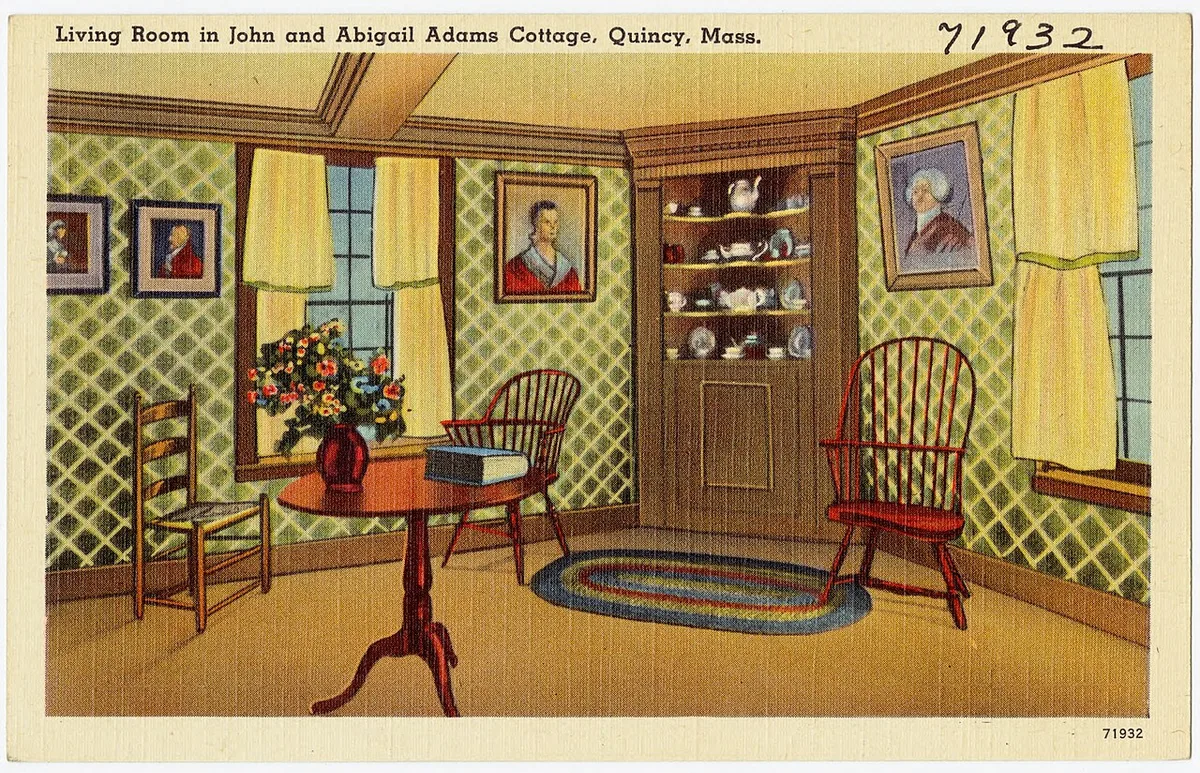
Image source: Wikimedia Commons / Tichnor Bros. Inc., Boston, Mass.
Scale the Sofa to the Room: Proportions That Work
Aim for a sofa filling roughly two thirds of the wall behind it. Wider crowds the room. Narrower leaves the seating floating.
A standard three-seater runs 200 to 230 cm (79 to 91 in), which suits most 3.6 m walls.
Leave room around the rest. Coffee tables read best at about two thirds the sofa's length. Walkways want 90 cm (36 in).
Seat to table should sit at 40 to 45 cm (16 to 18 in), close enough for a mug, far enough for shins.
Rugs do more work than people expect. Front legs on, back legs off, with 18 to 24 inches of rug showing past each end. That single move anchors a grey sofa and kills the rental-flat look.
Before you commit, measure the door.
Dimensions mean nothing if the frame won't clear your hallway. Our research into delivery complaints returns to the same culprit every time: a wide sofa and a tight turn. Getting a bulky piece indoors takes planning, not optimism.
Bodies like the American Society of Interior Designers treat proportion as the whole game, and with grey, proportion is what separates intentional from accidental.
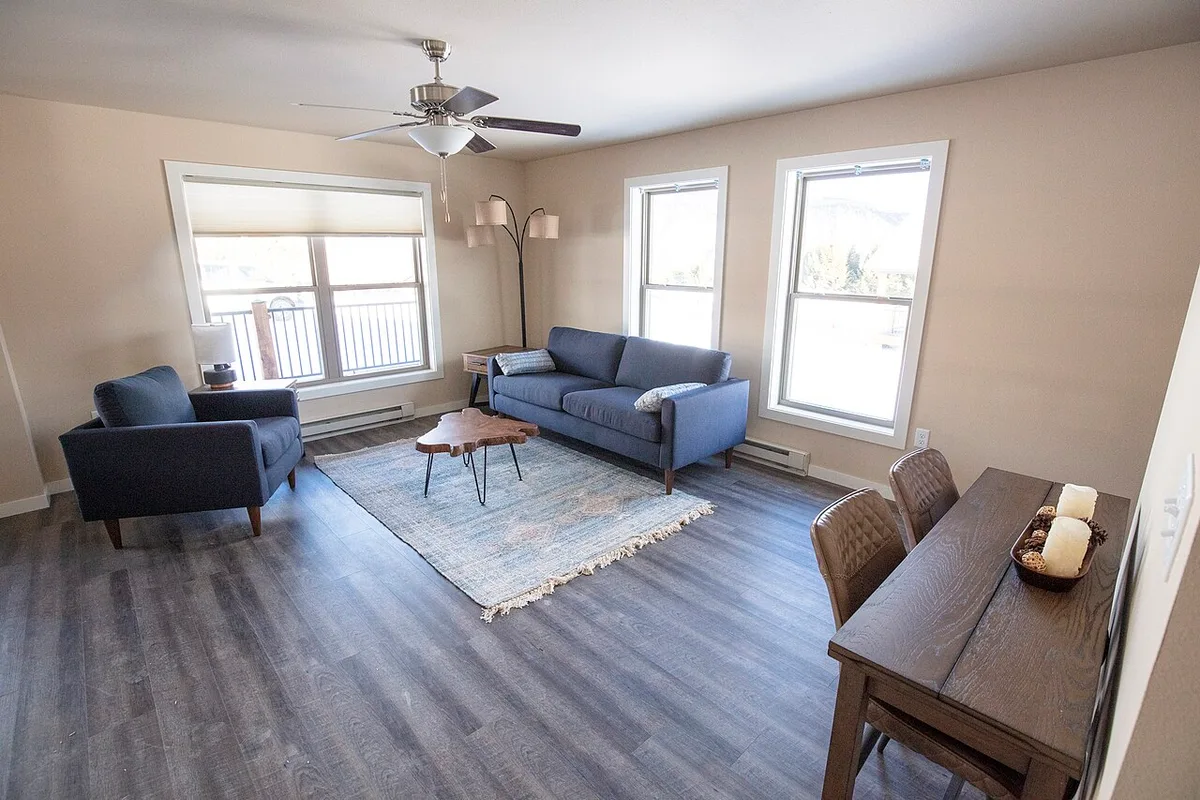
Image source: Wikimedia Commons / YellowstoneNPS
Layer Texture So the Space Doesn't Fall Flat
Grey's real weakness isn't the color. It's flatness. Texture is the fix.
Start with pillows, in odd numbers. Three or five, across two or three sizes: 50 cm squares at the back, a 45 cm in front, one 30 by 50 cm lumbar to finish. Keep the fills generous.
Under-stuffed cushions look cheap instantly.
Then mix materials that catch light differently. Boucle scatters it, velvet soaks it up, linen sits in between. Chunky knits add height.
Leather adds a hard edge. Aggregate reviews on grey upholstery mention the same pattern: the room feels finished the moment materials stop matching.
Why does grey leather feel so cold?
Because it looks cool and feels cool, and there's usually nothing soft nearby. If grey hide reads cold in your room, add a shearling throw and a wool rug. If you're still choosing fabric, velvet's staying power isn't nostalgia, it's just very good at looking rich in dim light.
Finish with two or three repeated wood tones and one metal that suits your undertone. Brass for warm grey, chrome or black for cool. Then layer the light: overhead, floor lamp, table lamp, all 2700K to 3000K.
Flat grey under flat lighting is the actual problem, not the sofa.
An accent chair that earns its place seals the composition, as long as its scale matches.
Visual Mistakes That Make Grey Feel Cold or Dull
The most common error is treating grey as a neutral that needs no help. It does. Without contrast, a grey sofa can make a room feel like a waiting room.
Cool grey paired with cool white walls is the fastest route to a sterile space. The eye sees no temperature shift, so everything flattens. Warm up the walls with cream or greige, or keep them white and lean into warm wood and textiles.
Lighting is the second silent killer. A single overhead bulb at 5000K will drain the life out of even the richest charcoal. Layer three sources at 2700K to 3000K.
Table lamp, floor lamp, and a dimmable overhead. That spread gives the grey somewhere to live.
Over-matching is another trap. Pillows, throws, and rugs in the same grey family look unfinished, not coordinated. Break the match with at least two other colors and three different textures.
Rugs deserve special mention. A grey sofa on a grey rug is a visual black hole. Introduce a pattern or a contrasting border.
Curtains in linen or velvet add height and break up the vertical.
Finally, bare walls above the sofa. Art is not decoration, it is the punctuation that tells the eye where to rest. A single large canvas in a warm tone does more than ten small frames.
Leg style matters more than you think. Tapered wood legs lift the sofa visually, while chunky plinth bases anchor it. Match leg tone to other wood in the room to tie the scheme together.
Style Cheat Sheet: Grey Shade + Design Direction Pairings
Your grey shade already points at a design direction. Follow it and the room comes together faster.
| Shade | Undertone | Style Pairings | Key Accents |
|---|---|---|---|
| Charcoal | Cool or neutral | Industrial, modern, loft | Black metal, raw wood, leather |
| Mid grey | Warm or neutral | Transitional, Scandinavian | Walnut, brass, boucle |
| Light grey | Cool | Minimalist, coastal | White oak, chrome, linen |
| Greige | Warm | Traditional, boho | Terracotta, olive, rattan |
Charcoal is the boldest grey. It suits industrial and modern rooms because it carries weight. Pair it with black metal, raw wood, and leather.
Keep the walls light so the sofa stays the focal point.
Mid grey is the flexible middle. It slides into transitional or Scandinavian schemes without effort. Walnut flooring, brass lamps, and boucle cushions make it feel intentional.
Light grey reads airy. It belongs in minimalist or coastal spaces where you want the room to breathe. White oak, chrome, and linen keep the palette quiet.
Greige is the chameleon. It works in traditional and boho rooms because it borrows from both. Terracotta, olive, and rattan bring out its warmth.
None of these are hard rules. A charcoal sofa in a boho room works if you add enough texture and warm wood. The cheat sheet is a starting point, not a cage.
Frequently Asked Questions
How do I know if my grey sofa is cool or warm?
Hold a fabric swatch against white paper in natural daylight. If it reads icy or bluish, it is cool. If it looks like diluted beige, it is warm.
If it shifts between the two as you tilt it, you have greige, which is the most forgiving undertone for mixing colors.
What colors pair well with a grey sofa?
Cool grey loves navy, blush, and chrome. Warm grey pairs with cream, rust, and brass. Greige tolerates almost anything, but terracotta, olive, and black always land well.
A grey sofa gives you a blank canvas that works with almost any palette. Use the 60-30-10 rule to keep the proportions balanced. For more on this, see our guide to complementary hues.
How can I make a grey living room feel warmer?
Swap cool bulbs for 2700K to 3000K. Add wood furniture, wool rugs, and textured cushions in cream or rust. A shearling throw on a grey leather sofa instantly softens the look.
Warm metals like brass also lift the mood in any room.
Can I mix patterns with a grey sofa?
Yes, as long as they share one color. A grey sofa is the neutral anchor. Introduce a floral pillow and a geometric rug that both pick up the same accent hue.
Keep scale in mind: one large pattern, one medium, and one small.
Is a grey sofa a good choice for resale?
It is the safest neutral in most markets. Buyers can picture their own cushions on it, and it hides wear better than cream. As of 2026, greige in particular is gaining ground with first-time buyers because it reads modern without locking them into a single style.