

How much does a wheelchair cost in 2026? A basic manual wheelchair may cost only a few hundred dollars. However, a powered or fully customized wheelchair can cost several thousand dollars.
The final price depends on the wheelchair type, frame material, seating system, controls, weight capacity and accessories. Your country, insurance plan and access to government funding also affect how much you pay.
This guide explains manual, electric, transport, custom, rental and used wheelchair prices. It also covers funding options in the USA, UK, Canada and Australia.
A basic manual wheelchair generally costs about $100 to $500 in the United States. Lightweight manual models often cost $300 to $800, while powered wheelchairs can range from approximately $1,200 to more than $25,000. Complex seating, standing functions and customized controls can increase the total cost significantly.
Prices in this guide are approximate retail ranges checked in July 2026. Actual prices may vary by brand, supplier, location, taxes, delivery costs and individual configuration.
Average Wheelchair Cost at a Glance
The following table provides a quick overview of common wheelchair prices in US dollars.
| Wheelchair Type | Typical Price Range | Best For |
|---|---|---|
| Transport wheelchair | $100–$400 | Short trips with a caregiver |
| Basic manual wheelchair | $100–$500 | Occasional or temporary use |
| Lightweight manual wheelchair | $300–$800 | Easier lifting and transportation |
| Ultra-lightweight wheelchair | $1,000–$5,000+ | Active and full-time users |
| Bariatric wheelchair | $300–$1,500+ | Higher weight capacities |
| Reclining manual wheelchair | $500–$2,500+ | Users needing adjustable positioning |
| Tilt-in-space wheelchair | $1,500–$5,000+ | Advanced postural and pressure support |
| Foldable electric wheelchair | $1,200–$3,500 | Travel and everyday powered mobility |
| Full-size power wheelchair | $3,500–$8,000+ | Regular indoor and outdoor use |
| Custom power wheelchair | $8,000–$25,000+ | Complex mobility and seating needs |
| Standing power wheelchair | $10,000–$30,000+ | Powered standing and positioning |
| Manual wheelchair power assist | $1,800–$7,000+ | Reducing effort while retaining a manual chair |
Current market listings show entry-level manual wheelchairs below $500, lightweight models around $300 to $800 and foldable power chairs starting near $1,200. Premium power-assist products can exceed $6,000.
These figures should be used as planning ranges rather than fixed quotes. A wheelchair built for occasional appointments is very different from one designed for all-day mobility and complex postural support.
How Much Does a Manual Wheelchair Cost?
A manual wheelchair normally costs between $100 and $5,000 or more. The wide range reflects major differences in frame weight, adjustability, durability and intended use.
A low-cost folding wheelchair may be suitable for temporary recovery or occasional outings. A full-time user may need an adjustable lightweight or custom rigid wheelchair that costs considerably more.

Standard Manual Wheelchair Cost
A standard manual wheelchair generally costs between $100 and $500.
These wheelchairs normally have:
- A steel or basic aluminium frame
- Folding cross-brace construction
- Fixed or removable armrests
- Swing-away footrests
- Solid tyres
- Basic fabric upholstery
- Limited adjustment options
Standard models can work well for short-term recovery, appointments, institutional use or occasional assistance.
However, they may be too heavy or inefficient for someone who needs to self-propel throughout the day. A heavy frame requires more effort to push and can be difficult to lift into a vehicle.
Lightweight Wheelchair Cost
A lightweight manual wheelchair normally costs between $300 and $800. More adjustable models may cost $1,000 or more.
Lightweight wheelchairs usually use aluminium instead of heavy steel. This reduces the amount of weight that a user or caregiver must lift.
They are often a better choice when the wheelchair must be:
- Folded regularly
- Loaded into a car
- Used for frequent appointments
- Pushed over longer distances
- Stored in a small space
Current Canadian retail examples show economy manual wheelchairs around CAD 250, standard models around CAD 295 to CAD 330 and super-lightweight folding models around CAD 660.
Ultra-Lightweight and Custom Manual Wheelchair Cost
An ultra-lightweight or custom manual wheelchair may cost from $1,000 to more than $5,000.
These wheelchairs are commonly designed for active or full-time users. They may use aluminium, titanium or carbon fibre to reduce weight and improve propulsion efficiency.
The price can increase when the chair includes:
- Custom seat width and depth
- Adjustable rear axle position
- A rigid frame
- Quick-release wheels
- Ergonomic handrims
- Performance casters
- Custom back support
- Pressure-relieving cushions
- Suspension components
- Premium frame colours
- Sports or active-use configurations
A correctly configured active wheelchair may require less pushing effort than a basic folding chair. However, it should be selected according to the user’s measurements, strength, posture, transfer method and environment.
Bariatric Wheelchair Cost
A bariatric or heavy-duty wheelchair usually costs between $300 and $1,500. Highly specialized models can cost more.
Bariatric wheelchairs generally include:
- A reinforced frame
- A wider seat
- Stronger cross braces
- Higher-capacity wheels
- Heavy-duty upholstery
- Increased weight capacity
The correct seat width is important. A seat that is too narrow can cause discomfort and pressure, while an unnecessarily wide seat can make self-propulsion less efficient.
Current Canadian listings include heavy-duty manual wheelchairs with capacities up to 500 pounds at prices above standard economy models.
Reclining Wheelchair Cost
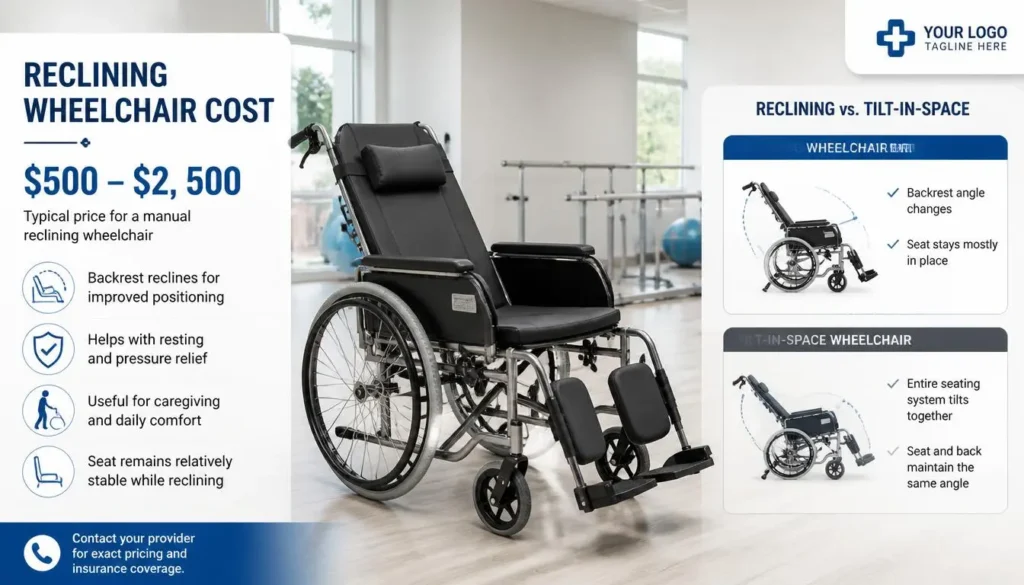
A reclining manual wheelchair usually costs between $500 and $2,500.
The backrest reclines while the seat remains relatively stable. This feature may help with positioning, resting or certain care activities.
A reclining wheelchair is not the same as a tilt-in-space wheelchair. Reclining changes the angle between the back and seat. Tilt-in-space changes the orientation of the entire seating system while maintaining the seated angle.
Tilt-in-Space Wheelchair Cost
A manual tilt-in-space wheelchair can cost between $1,500 and $5,000 or more.
It may be considered for people who require:
- Advanced postural support
- Pressure redistribution
- Assistance maintaining an upright position
- Head and trunk support
- Frequent position changes
- Caregiver-operated mobility
A clinical assessment is advisable before purchasing a tilt-in-space wheelchair. The seating system, headrest, cushion, foot support and tilt range must work together.
How Much Does a Transport Wheelchair Cost?
A transport wheelchair generally costs between $100 and $400. Premium lightweight or bariatric models may cost $400 to $800 or more.
Transport chairs have four small wheels and are designed to be pushed by a caregiver. They are not normally intended for independent self-propulsion.
Their main advantages include:
- Lower weight
- Compact folding
- Easy car storage
- Simple caregiver operation
- Lower purchase price
A transport wheelchair may be suitable for medical appointments, airports, shopping trips and short outings.
It may not be appropriate for someone who wants to move independently. The small rear wheels do not provide the same self-propulsion capability as a standard manual wheelchair.
Canadian retail examples currently place common transport chairs around CAD 250, with heavier-duty and combination models costing more.
How Much Does an Electric Wheelchair Cost?
An electric wheelchair usually costs between $1,200 and $25,000 or more.
Basic foldable electric chairs are available at the lower end. Full-size power wheelchairs with customized seating, suspension and advanced controls cost significantly more.
Basic Electric Wheelchair Cost
A basic electric wheelchair commonly costs between $1,200 and $3,500.
It may include:
- Joystick control
- Standard padded seating
- Rechargeable batteries
- Foldable or portable construction
- Basic indoor and outdoor capability
- A limited number of adjustments
Entry-level electric wheelchairs can be suitable for people who need powered mobility but do not require complex postural support.
The lowest price should not be the only consideration. Buyers should also compare the warranty, battery availability, replacement parts, turning radius, braking system and local repair support.
Foldable Electric Wheelchair Cost
A foldable electric wheelchair usually costs between $1,200 and $3,500 in the United States.
UK retail listings checked in July 2026 showed folding electric wheelchairs beginning below £700, with many lightweight models priced between approximately £800 and £1,400.
Important features to compare include:
- Total wheelchair weight
- Lifting weight after removing the battery
- Folded dimensions
- Battery range
- Charging time
- Seat width
- User weight capacity
- Airline battery documentation
- Motor power
- Tyre type
- Warranty coverage
“Airline-friendly” does not automatically mean every airline will accept the wheelchair without advance notice. Travellers should confirm the battery details and mobility-device procedure directly with the airline.
Full-Size Power Wheelchair Cost
A full-size power wheelchair generally costs between $3,500 and $8,000 or more.
These wheelchairs may provide:
- Stronger motors
- Improved suspension
- Longer driving range
- Larger batteries
- Better outdoor performance
- More seating adjustments
- Front-, mid- or rear-wheel drive
- Higher user weight capacities
A full-size power chair is often heavier than a folding travel model. Transportation may require a wheelchair-accessible vehicle, ramp, hoist or vehicle lift.
Custom Power Wheelchair Cost
A custom power wheelchair commonly costs between $8,000 and $25,000. Some complex systems can exceed $30,000.
The price may include:
- Custom seat dimensions
- Pressure-relieving cushions
- Contoured back support
- Head and lateral supports
- Power tilt
- Power recline
- Elevating leg rests
- Seat elevation
- Alternative drive controls
- Specialty electronics
- Attendant controls
- Environmental controls
- Clinical fitting and programming
A custom power wheelchair should not be selected only from an online product description. It may require input from an occupational therapist, physiotherapist, rehabilitation engineer or specialist wheelchair provider.
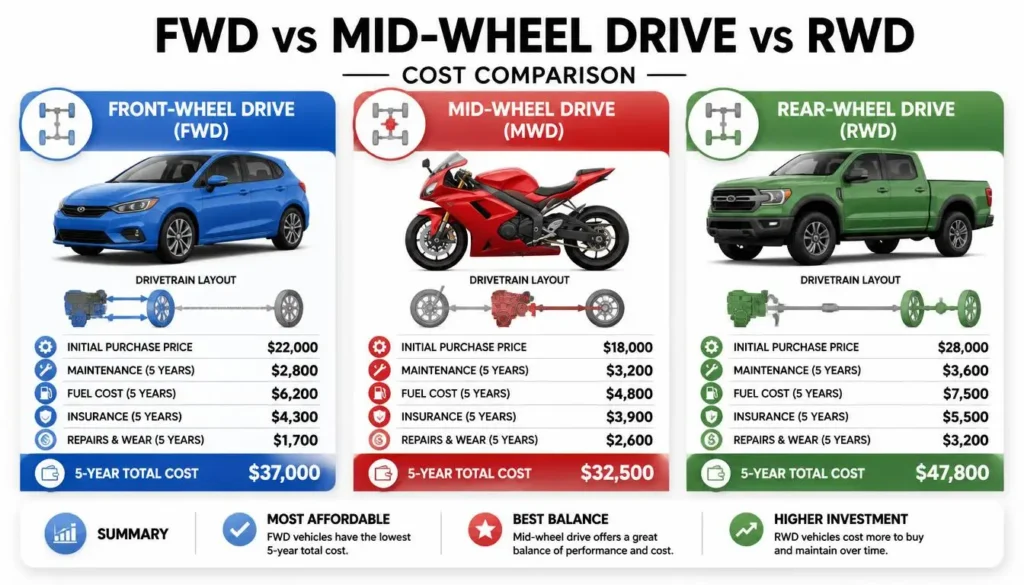
Front-Wheel vs Mid-Wheel vs Rear-Wheel Drive Costs
Drive configuration affects how a power wheelchair handles.
Front-Wheel Drive
Front-wheel-drive chairs pull the wheelchair from the front. They can perform well over obstacles and may provide good outdoor stability.
However, their turning behaviour may take time to learn.
Mid-Wheel Drive
Mid-wheel-drive chairs turn around a central point. They often provide a small turning radius, making them useful in homes and other tight indoor spaces.
They commonly use additional front and rear casters for stability.
Rear-Wheel Drive
Rear-wheel-drive chairs push from behind and may feel stable at higher outdoor speeds.
However, they can require more space when turning.
The drive type itself does not determine the entire price. Seating, suspension, electronics, battery capacity and customization normally have a larger effect on the final cost.
How Much Does a Wheelchair Power-Assist System Cost?
A wheelchair power-assist system usually costs between $1,800 and $7,000 or more.
Power-assist equipment adds motorized support to a compatible manual wheelchair. It can reduce the physical effort required to travel longer distances, climb slopes or cross uneven surfaces.
Common systems include:
- Rear-mounted drive units
- Powered rear wheels
- Joystick-controlled add-ons
- Front-mounted powered attachments
- Caregiver-controlled push assistance
Current US examples range from approximately $1,799 for a basic power attachment to more than $6,600 for a premium SmartDrive system.
Before purchasing, confirm:
- Wheelchair compatibility
- Total added weight
- Maximum user capacity
- Battery range
- Control method
- Installation requirements
- Airline transport rules
- Warranty terms
- Availability of replacement parts
A power assist can cost more than some low-priced folding electric wheelchairs. However, it allows the user to retain the seating, handling and compact size of a manual wheelchair.
How Much Do Specialty Wheelchairs Cost?
Specialty wheelchair prices vary widely because many are designed for a particular activity, environment or clinical need.
| Specialty Wheelchair | Typical Price Range |
|---|---|
| Pediatric wheelchair | $500–$5,000+ |
| Sports wheelchair | $1,500–$8,000+ |
| Standing power wheelchair | $10,000–$30,000+ |
| Beach wheelchair | $1,000–$5,000+ |
| All-terrain wheelchair | $3,000–$20,000+ |
| Shower or commode wheelchair | $200–$2,500+ |
| Stair-climbing wheelchair | $5,000–$20,000+ |
Pediatric Wheelchair Cost
A pediatric wheelchair may cost between $500 and $5,000 or more.
Children may require adjustable components that accommodate growth. The wheelchair may also include postural supports, harnesses, headrests, tilt functions or custom seating.
The cheapest model may become unsuitable quickly if it cannot adapt to changing needs.
Sports Wheelchair Cost
A sports wheelchair generally costs between $1,500 and $8,000 or more.
Basketball, racing, tennis and rugby wheelchairs use different frame designs. Many are built according to the athlete’s measurements, playing position and competition requirements.
Standing Wheelchair Cost
A standing power wheelchair can cost from approximately $10,000 to more than $30,000.
These models include mechanisms that raise the user from sitting into a supported standing position. They require careful assessment, configuration and user training.
Beach and All-Terrain Wheelchair Cost
A beach wheelchair may cost between $1,000 and $5,000. Powered all-terrain models can cost considerably more.
Large balloon tyres, suspension, stronger motors and corrosion-resistant materials contribute to the higher price.
Some parks, beaches and visitor centres provide these wheelchairs for public use, which may reduce the need to purchase one privately.
Wheelchair Prices by Country
Wheelchair prices cannot be compared accurately by converting currencies alone. Taxes, funding systems, import costs, supplier networks and included services vary between countries.
How Much Does a Wheelchair Cost in the USA?
Typical private prices in the United States include:
| Wheelchair Type | Approximate US Price |
|---|---|
| Basic manual wheelchair | $100–$500 |
| Lightweight manual wheelchair | $300–$800 |
| Custom manual wheelchair | $1,000–$5,000+ |
| Foldable electric wheelchair | $1,200–$3,500 |
| Full-size power wheelchair | $3,500–$8,000+ |
| Complex custom power wheelchair | $8,000–$25,000+ |
Medicare Part B may cover medically necessary wheelchairs as durable medical equipment when its requirements are met.
For a power wheelchair or scooter, Medicare requires a face-to-face examination and a written prescription from a treating provider. Certain power wheelchair types may also require prior authorization.
After the Part B deductible, a beneficiary generally pays 20% of the Medicare-approved amount when the supplier accepts assignment. Medicare may require some equipment to be rented, purchased or rented before ownership transfers.
Medicaid and private insurance rules vary by state and plan. Always confirm network suppliers, documentation requirements, deductibles, coinsurance and excluded upgrades before ordering.
How Much Does a Wheelchair Cost in the UK?
Private UK prices commonly begin at approximately:
| Wheelchair Type | Approximate UK Price |
|---|---|
| Basic manual wheelchair | £100–£300 |
| Lightweight manual wheelchair | £250–£1,000+ |
| Active or custom manual wheelchair | £1,000–£5,000+ |
| Folding electric wheelchair | £600–£2,000+ |
| Full-size powerchair | £2,000–£8,000+ |
| Complex custom powerchair | £5,000–£20,000+ |
The NHS states that privately purchased wheelchairs range from around £150 for a manual model to around £2,000 for a basic electric wheelchair. It recommends considering comfort, intended environment, frequency of use and maintenance costs before buying.
Eligible users can be referred to a local NHS wheelchair service for an assessment. Some areas also allow self-referral.
In England, a Personal Wheelchair Budget can provide more choice over how assessed wheelchair needs are met. The budget may be used within NHS services or, depending on the available option, toward an alternative wheelchair.
How Much Does a Wheelchair Cost in Canada?
Typical Canadian retail prices include:
| Wheelchair Type | Approximate Canadian Price |
|---|---|
| Economy manual wheelchair | CAD 250–400 |
| Lightweight manual wheelchair | CAD 500–1,200+ |
| Bariatric wheelchair | CAD 475–1,500+ |
| Foldable electric wheelchair | CAD 2,500–5,000+ |
| Custom power wheelchair | CAD 8,000–25,000+ |
Current Canadian retailer examples include economy manual wheelchairs near CAD 250, standard wheelchairs near CAD 295 to CAD 330 and lightweight folding chairs near CAD 660. A current electric wheelchair range from the same market includes models between approximately CAD 2,795 and CAD 4,350.
Wheelchair funding differs by province.
Ontario’s Assistive Devices Program helps eligible residents with long-term physical disabilities pay for customized mobility equipment. Covered categories include manual wheelchairs, power wheelchairs, scooters and some power add-ons.
People outside Ontario should check their provincial health authority, disability programme, veterans’ coverage, workplace benefits and private insurance.
How Much Does a Wheelchair Cost in Australia?
Typical Australian prices include:
| Wheelchair Type | Approximate Australian Price |
|---|---|
| Basic manual wheelchair | AUD 200–600 |
| Lightweight manual wheelchair | AUD 500–2,000+ |
| Folding electric wheelchair | AUD 2,390–4,590 |
| Heavy-duty power wheelchair | From approximately AUD 5,990 |
| Standing or all-terrain power wheelchair | AUD 6,990–10,000+ |
| Complex powered seating system | AUD 15,000+ |
Current Australian retailer guidance places folding and reclining electric wheelchairs around AUD 2,390 to AUD 4,590. Heavy-duty models begin near AUD 5,990, while standing and all-terrain models can begin around AUD 6,990 to AUD 9,800.
The NDIS may fund assistive technology when it is related to the participant’s disability and meets the applicable funding rules.
Current NDIS guidance defines mid-cost assistive technology as costing between AUD 1,500 and AUD 15,000. High-cost assistive technology costs more than AUD 15,000, and powered wheelchairs with seating are listed as an example. High-cost equipment generally requires a qualified assessment, and a trial or rental may be requested.
How Much Does a Wheelchair Cost Without Insurance?
Without insurance or government funding, the buyer is responsible for the purchase price and any related expenses.
Typical out-of-pocket costs may include:
- Wheelchair purchase
- Clinical assessment
- Custom fitting
- Delivery
- Assembly
- Cushion
- Back support
- Batteries
- Charger
- Accessories
- Maintenance
- Repairs
- Vehicle transport equipment
- Home accessibility changes
A basic manual wheelchair may cost less than $500 out of pocket. A complex custom power wheelchair can exceed $25,000 before ramps, lifts, transportation and home modifications are considered.
Before paying privately, ask the supplier for a detailed written quotation. The quotation should separate the base wheelchair price from accessories, seating, delivery, fitting and ongoing service.
Why Are Some Wheelchairs So Expensive?
A wheelchair is not always a simple chair with wheels. For a full-time user, it may function as a mobility system, seating system and postural support system.
Several factors make advanced wheelchairs expensive.
Custom Manufacturing
Custom frames may be built according to an individual’s seat width, seat depth, leg length, back height and centre of gravity.
Unlike mass-produced chairs, these products may require individual engineering and assembly.
Lightweight Materials
Titanium and carbon fibre can reduce weight while maintaining strength. These materials and their manufacturing processes cost more than basic steel.
Complex Seating
A customized cushion and backrest may be required to support posture, improve comfort and manage pressure.
Positioning components can include:
- Lateral trunk supports
- Pelvic belts
- Headrests
- Thigh guides
- Knee supports
- Customized footplates
- Contoured cushions
- Molded seating
Powered Functions
Power tilt, recline, leg elevation, standing and seat elevation require motors, actuators, electronics and specialized controls.
Each powered function increases the product’s complexity.
Alternative Controls
Some people cannot use a standard joystick. A power wheelchair may therefore need head controls, chin controls, switches, attendant controls or sip-and-puff operation.
These systems require programming, mounting and testing.
Specialist Assessment and Support
The price may include professional evaluation, fitting, adjustment, delivery, training and follow-up.
A lower online price may not include these services.
Low Production Volumes
Specialized wheelchairs are produced in much smaller quantities than common consumer products. Manufacturers must spread research, testing and regulatory costs across fewer units.
What Factors Affect the Cost of a Wheelchair?
Manual vs Electric Operation
Manual wheelchairs have fewer mechanical and electronic components. Electric wheelchairs include motors, batteries, controllers, wiring and charging systems.
Frame Material
Steel is strong and affordable but heavy. Aluminium is lighter and often more expensive. Titanium and carbon fibre may provide lower weight at a premium price.
Standard vs Custom Sizing
Standard-size wheelchairs are mass-produced. Custom frames require individual measurements and configuration.
Weight Capacity
A higher user weight capacity requires stronger frames, wheels, upholstery and components.
Seating and Positioning
The base wheelchair price may not include an appropriate cushion or backrest. Complex seating can add thousands of dollars.
Folding vs Rigid Frame
Folding frames are convenient for storage. Rigid frames can offer better propulsion efficiency and lower weight but may cost more.
Indoor vs Outdoor Performance
Outdoor power wheelchairs may require stronger motors, suspension, larger wheels and higher-capacity batteries.
Battery Capacity
Larger or higher-quality batteries increase range but also affect price and weight.
Control System
A standard joystick is normally less expensive than head, chin, switch or sip-and-puff controls.
Warranty and Local Support
Products with stronger warranties and established service networks may cost more than unbranded online alternatives.
Hidden and Ongoing Wheelchair Costs
The purchase price is only one part of the total wheelchair budget.
| Additional Expense | Why It May Be Needed |
|---|---|
| Seat cushion | Comfort, positioning or pressure management |
| Back support | Postural support |
| Spare battery | Longer range or emergency backup |
| Battery replacement | Restores electric wheelchair performance |
| Tyres and tubes | Normal wear or puncture repair |
| Casters and bearings | Smooth and safe movement |
| Brake servicing | Safe transfers and parking |
| Delivery and setup | Large or complex equipment |
| Clinical assessment | Correct sizing and configuration |
| Vehicle ramp or lift | Wheelchair transportation |
| Home ramp | Step-free access |
| Doorway modifications | Space for wider wheelchairs |
| Annual servicing | Preventive maintenance |
| Extended warranty | Protection after the standard warranty |
Ask whether the quoted price includes the seat cushion, charger, footrests, armrests, delivery and setup. Items that appear standard in a product image may be optional.
What Is the Total Cost of Owning a Wheelchair?
The total cost of ownership includes the initial purchase and all costs incurred during use.
First-Year Costs
First-year expenses may include:
- Wheelchair purchase
- Assessment
- Seating and accessories
- Delivery
- Training
- Home access changes
- Vehicle transportation equipment
- Insurance or protection plan
Annual Maintenance Costs
Manual wheelchair maintenance may involve tyre replacement, caster servicing, bearing cleaning, brake adjustment and upholstery replacement.
Power wheelchair maintenance can also include batteries, controllers, motors, wiring and charging equipment.
Five-Year Cost
A low-priced wheelchair can become expensive if replacement parts are unavailable or major components fail frequently.
Before buying, ask:
- How long is the frame warranty?
- How long are electronics covered?
- Is the battery covered?
- Who performs local repairs?
- Are replacement parts stocked?
- Does the warranty include labour?
- Who pays shipping for repairs?
- Is loan equipment available?
How Much Does It Cost to Rent a Wheelchair?
Wheelchair rental prices depend on the wheelchair type, city, rental period, delivery and demand.
Typical US manual wheelchair rental prices include:
- Approximately $20–$50 per day
- Approximately $30–$100 per week in lower-cost markets
- Approximately $100–$250 per month
- Higher prices in major tourist destinations
Electric wheelchair rentals may cost:
- Approximately $30–$80 per day
- Approximately $150–$350 per week
- Approximately $500–$1,200 per month
Published US rental examples show manual wheelchair rates around $30 to $60 per week in some markets. Location-specific weekly rates can be substantially higher in cities such as New York.
Australian manual wheelchair hire can begin around AUD 20 to AUD 35 per week, depending on the supplier and chair type.
Rental charges may also include:
- Refundable deposit
- Delivery fee
- Collection fee
- Damage protection
- Cleaning charge
- Late-return fee
- Minimum rental period
Should You Buy or Rent a Wheelchair?
Renting may be better when:
- The wheelchair is needed temporarily
- The user is recovering from surgery
- The user has a short-term injury
- The wheelchair is needed during travel
- A permanent prescription is still being prepared
- The user wants to trial a model
Buying may be better when:
- The wheelchair will be used long term
- A custom fit is required
- The user needs independent daily mobility
- Specific seating support is necessary
- Rental charges would exceed the purchase price
- Consistent availability is important
For complex or high-cost assistive technology, a formal trial can help identify problems before a final purchase.
New vs Used Wheelchair Cost
A used wheelchair may cost 30% to 70% less than an equivalent new model. However, the saving depends on its condition, age, configuration and remaining warranty.
| Factor | New Wheelchair | Used Wheelchair |
|---|---|---|
| Purchase price | Higher | Usually lower |
| Warranty | Normally included | May be expired |
| Custom fit | Easier to configure | May not match the user |
| Battery condition | New | May be degraded |
| Repair risk | Usually lower | Potentially higher |
| Return options | Supplier dependent | Often limited |
| Clinical fitting | May be available | Usually separate |
| Replacement parts | Easier to confirm | May be discontinued |
Before buying a used wheelchair, inspect:
- Frame cracks
- Bent components
- Rust or corrosion
- Upholstery condition
- Brakes
- Tyres
- Casters
- Bearings
- Footrests
- Armrests
- Seat dimensions
- Battery age
- Charger condition
- Joystick operation
- Error codes
- Product recalls
- Replacement-part availability
A used custom wheelchair may be inexpensive but unsuitable. Small differences in seat width, depth, back height or axle position can affect comfort and function.
Does Insurance or Government Funding Cover a Wheelchair?
Wheelchair funding depends on the country, programme and individual eligibility.
| Country | Possible Funding Sources |
|---|---|
| USA | Medicare, Medicaid, private insurance, veterans’ programmes |
| UK | NHS wheelchair services, Personal Wheelchair Budgets, Motability |
| Canada | Provincial programmes, private insurance, disability benefits |
| Australia | NDIS, DVA, state programmes and other eligible supports |
Coverage is not guaranteed.
A funding organization may require:
- Evidence of medical necessity
- A prescription
- A mobility assessment
- A trial
- Multiple quotations
- An approved supplier
- Prior authorization
- Documentation showing why a lower-cost option is unsuitable
Upgrades chosen for preference rather than assessed need may not be fully funded.
How Can You Pay for a Wheelchair?
When insurance or government funding does not cover the full cost, other options may include:
- Supplier payment plans
- Medical financing
- Disability grants
- Charitable organizations
- Veterans’ support
- Workplace accommodation funding
- University disability support
- Community fundraising
- Nonprofit equipment programmes
- Used-equipment exchanges
- Manufacturer assistance programmes
Read financing terms carefully. A low monthly payment can result in a much higher total cost when interest and fees are included.
Before applying to a charity, prepare:
- A clinical recommendation
- A detailed supplier quotation
- Proof of funding denial or shortfall
- A description of how the wheelchair will improve daily activities
- Any required income documentation
Wheelchair vs Mobility Scooter: Which Costs Less?
A mobility scooter may cost less than a complex power wheelchair, but price should not be the only deciding factor.
| Factor | Power Wheelchair | Mobility Scooter |
|---|---|---|
| Control | Joystick or alternative controls | Tiller steering |
| Turning space | Often smaller | Usually larger |
| Seating support | Basic to highly customized | Usually limited |
| Transfers | May support specialized transfers | User must usually transfer independently |
| Indoor use | Often better in tight spaces | Depends on size |
| Outdoor range | Varies | Often designed for distance |
| Transport | May require a lift | May disassemble or require a lift |
| Funding | Based on assessed need | Based on eligibility and need |
A scooter usually requires the user to maintain sitting balance, operate a tiller and transfer on and off safely.
A power wheelchair may be more appropriate when the user requires postural support, a smaller turning radius or alternative controls.
How Much Should You Spend on a Wheelchair?
The right budget depends on how the wheelchair will be used.
Temporary Recovery
For a short recovery after injury or surgery, a basic manual wheelchair or rental may be sufficient.
Expected budget:
- Purchase: $100–$500
- Rental: $30–$100 per week in many areas
Occasional Trips
For appointments, shopping or family outings, consider a transport chair or lightweight folding wheelchair.
Expected budget:
- $150–$800
Daily Independent Use
A full-time manual wheelchair user may benefit from an adjustable lightweight or custom rigid chair.
Expected budget:
- $1,000–$5,000+
Powered Everyday Mobility
Someone who cannot self-propel may require a folding or full-size power chair.
Expected budget:
- $1,200–$8,000+
Complex Postural Needs
A person requiring tilt, recline, custom seating or alternative controls may need a complex rehabilitation wheelchair.
Expected budget:
- $8,000–$30,000+
The lowest purchase price may not provide the lowest long-term cost. Correct fit, reliability, repair support and suitability are more important than finding the cheapest listing.
Where Can You Buy a Wheelchair?
Wheelchairs are available from:
- Medical equipment stores
- Mobility specialists
- Rehabilitation suppliers
- Authorized durable medical equipment suppliers
- Online wheelchair retailers
- Pharmacies
- Large retail marketplaces
- Used-equipment dealers
- Charity resale programmes
A specialist supplier may charge more than a general online retailer. However, the price may include assessment, fitting, assembly, adjustment and after-sales support.
Before ordering online, verify:
- The exact seat width and depth
- The wheelchair’s total weight
- The maximum user weight
- The return policy
- Restocking fees
- Whether customized products can be returned
- Warranty length
- Local repair availability
- Replacement-part availability
- Delivery and assembly charges
For Medicare-funded equipment, both the healthcare provider and DME supplier must meet Medicare requirements.
What Should a Wheelchair Warranty Cover?
Wheelchair warranties vary by manufacturer.
A warranty may cover:
- Frame defects
- Structural components
- Motors
- Controllers
- Electronics
- Chargers
- Batteries
- Upholstery
- Labour
Common exclusions include:
- Normal tyre wear
- Damage from misuse
- Water damage
- Unauthorized modifications
- Accidents
- Incorrect charging
- Commercial use
- Shipping costs
- Labour after a limited period
Ask whether the warranty is transferable. This is important when buying or selling a used wheelchair.
Also confirm whether the supplier provides a replacement or loan wheelchair during long repairs.
How Long Does a Wheelchair Last?
A basic manual wheelchair may last several years when used occasionally and maintained properly. A high-quality custom wheelchair may also provide years of service, but parts such as tyres, casters, upholstery and bearings will require attention.
Wheelchair lifespan depends on:
- Daily usage
- User weight
- Terrain
- Weather exposure
- Maintenance
- Frame material
- Transportation damage
- Product quality
- Availability of replacement parts
- Changes in the user’s needs
A wheelchair should be reviewed when:
- The frame is damaged
- Repairs become frequent
- Replacement parts are unavailable
- The seating no longer fits
- The user’s mobility changes
- The battery range declines significantly
- The wheelchair becomes unsafe
- The cost of repair approaches replacement cost
How to Choose the Right Wheelchair for Your Budget
Follow these steps before purchasing.
1. Define the Purpose
Decide whether the wheelchair is for temporary recovery, occasional trips, daily use, sports, travel or complex mobility support.
2. Choose the Propulsion Type
Determine whether the user will self-propel, be pushed by a caregiver or use electric controls.
3. Measure the User
Important measurements may include:
- Seat width
- Seat depth
- Lower-leg length
- Back height
- Armrest height
- Overall body dimensions
4. Check the Weight Capacity
Never choose a wheelchair with a capacity below the user’s weight.
Account for bags, medical equipment and other items carried on the wheelchair.
5. Review the Environment
Measure:
- Doorways
- Hallways
- Lift entrances
- Vehicle storage space
- Turning areas
- Ramp widths
6. Consider Transportation
Check whether the chair folds, disassembles or requires a vehicle lift.
7. Calculate the Full Cost
Include the cushion, accessories, maintenance, batteries, transport and home access changes.
8. Check Funding Before Buying
Some programmes will not reimburse a wheelchair purchased before approval.
9. Trial the Wheelchair
Test the wheelchair on realistic surfaces whenever possible.
10. Get Professional Advice When Needed
Complex mobility, positioning or pressure-management needs require more than an online sizing chart.
Is a Cheap Wheelchair Worth Buying?
A cheap wheelchair can be a sensible purchase for temporary or occasional use.
It may be suitable when:
- The user needs short-term assistance
- A caregiver will push the chair
- The chair will be used only for appointments
- Complex seating is not required
- The product has an appropriate weight capacity
A cheap wheelchair may be a poor choice when:
- It will be used all day
- The user must self-propel long distances
- The frame is too heavy
- The seat does not fit
- The user requires postural support
- Repairs and replacement parts are unavailable
- The warranty is unclear
The correct wheelchair is the one that safely meets the user’s needs. It is not automatically the cheapest or most expensive option.
When Should You Get a Professional Wheelchair Assessment?
Consider a professional assessment when the wheelchair will be used daily or when the user has complex needs.
Assessment is especially important for:
- Full-time wheelchair use
- Children
- Progressive conditions
- Poor trunk control
- Significant asymmetry
- Pressure-injury risk
- Tilt or recline requirements
- Standing functions
- Custom power controls
- Difficult transfers
- Head or lateral support
- Frequent pain or discomfort
- Repeated wheelchair breakdowns
A qualified professional can evaluate body measurements, posture, mobility goals, home access, transportation and caregiver requirements.
Frequently Asked Questions
What Is the Average Cost of a Wheelchair?
A basic manual wheelchair generally costs between $100 and $500. Lightweight models may cost $300 to $800, while custom manual chairs can exceed $5,000. Electric wheelchair prices often range from $1,200 to more than $25,000.
How Much Does a Basic Manual Wheelchair Cost?
A basic manual wheelchair usually costs between $100 and $500. The price depends on frame material, seat width, weight capacity, footrests, armrests and brand.
How Much Does an Electric Wheelchair Cost?
An electric wheelchair generally costs between $1,200 and $25,000 or more. Folding travel models cost less than complex power wheelchairs with customized seating, tilt, recline or alternative controls.
How Much Does a Transport Wheelchair Cost?
A transport wheelchair normally costs between $100 and $400. Lightweight, bariatric and premium transport models may cost more.
How Much Does a Lightweight Wheelchair Cost?
A lightweight manual wheelchair commonly costs between $300 and $800. Highly adjustable or ultra-lightweight models can cost between $1,000 and $5,000 or more.
How Much Does a Wheelchair Cost Without Insurance?
Without insurance, a basic manual wheelchair may cost less than $500. A custom power wheelchair may cost $8,000 to $25,000 or more before accessories, fitting, delivery and maintenance.
Why Are Custom Wheelchairs So Expensive?
Custom wheelchairs require individual measurements, specialized components, lightweight materials, clinical fitting and lower-volume manufacturing. Advanced seating, powered positioning and alternative controls further increase the price.
Does Medicare Pay for a Wheelchair?
Medicare Part B may cover a medically necessary wheelchair when its requirements are met. Power wheelchair coverage requires a face-to-face examination and written prescription. Some models also need prior authorization.
Can You Get a Free Wheelchair Through the NHS?
Eligible users may receive an NHS-provided wheelchair after assessment by a local wheelchair service. Availability and the type of wheelchair supplied depend on assessed clinical needs and local eligibility rules.
Does the NDIS Cover Electric Wheelchairs?
The NDIS may fund a powered wheelchair when it is disability-related and meets NDIS funding rules. Complex and high-cost wheelchairs normally require professional evidence and assessment. A trial may also be requested.
Can You Rent a Wheelchair Instead of Buying One?
Yes. Wheelchairs can be rented by the day, week or month. Renting is often suitable for recovery, holidays, travel or short-term mobility needs.
Is It Safe to Buy a Used Wheelchair?
A used wheelchair can be safe when it is structurally sound, correctly sized and professionally inspected. Check the frame, brakes, wheels, batteries, controls, charger, recall status and replacement-part availability.
Do You Need a Prescription to Buy a Wheelchair?
You normally do not need a prescription to purchase a wheelchair privately. However, insurance or government funding may require a prescription, assessment or evidence of medical necessity.
Are Wheelchair Cushions Included in the Price?
Some wheelchairs include a basic cushion, while others do not. Pressure-relieving or custom cushions are often sold separately. Confirm exactly what is included before ordering.
How Often Do Electric Wheelchair Batteries Need Replacing?
Battery life depends on battery type, charging habits, temperature, user weight and frequency of use. Replace a battery when it no longer holds sufficient charge or its range declines significantly.
Can You Finance a Wheelchair?
Many mobility retailers offer payment plans or third-party financing. Compare the interest rate, fees, repayment period and total amount payable before signing an agreement.
Is a Wheelchair Cheaper Than a Mobility Scooter?
A basic manual wheelchair is normally cheaper than a mobility scooter. However, a complex power wheelchair can cost much more. The correct choice depends on seating, control, transfer and mobility needs rather than price alone.
How Long Does a Wheelchair Usually Last?
A wheelchair may last several years with suitable maintenance. Lifespan depends on construction quality, usage, terrain, maintenance and whether the user’s physical needs change.
Final Thoughts on Wheelchair Costs
So, how much does a wheelchair cost? A basic manual wheelchair may cost between $100 and $500, while a lightweight or custom manual model can cost several thousand dollars. Electric wheelchair prices commonly begin around $1,200 and can exceed $25,000 for advanced custom systems.
Do not choose a wheelchair based only on its lowest advertised price. Consider fit, comfort, intended use, maintenance, warranty, replacement parts and long-term support.
Check insurance and government funding before placing an order. For full-time use, custom seating or complex mobility needs, arrange an assessment with a qualified wheelchair professional.