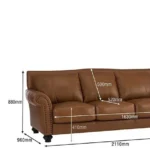
What is a traditional sofa? It's an upholstered seat styled after classic English design. Rolled arms, exposed wood legs, and a shaped back define it.
The silhouette reads formal, warm, and deliberate.
Our research across manufacturer spec sheets keeps landing on the same figures. Seat depths run 21 to 24 inches, overall widths 72 to 96 inches. Those numbers hold whether the frame is bench-made or imported.
Here's how to read the style by eye.
What Is a Traditional Sofa?
A traditional sofa is an upholstered seat styled after classic English design. It carries rolled arms, exposed wood legs, and a shaped back. Camelback, wingback, and Chesterfield profiles all qualify.
Nailhead trim and welting finish the look.
Why Visuals Matter When Identifying a Traditional Sofa
A photo tells you more than any spec sheet. Two sofas can share an 84-inch width, a 21-inch seat depth, and a 19-inch seat height. One still reads formal, the other casual.
The difference lives in the arm curve and the leg turn.
Our research across bench-made and mass-market lines found the same pattern. Builders list near-identical dimensions for a Queen Anne camelback and a modern rolled-arm sofa. Only the profile separates them.
A silhouette sketch shows three zones. Read those first.
- Back line: arched camelback, winged, or tight straight back
- Arm line: scroll roll, low track, or saddle curve
- Base line: exposed apron, turned legs, or full skirt
A rolled arm that sweeps into the back reads English. A squared arm with a tight back reads transitional. That single cue settles most showroom arguments.
Pictures also expose trim quality. Nailhead spacing, welting, and pleat work are visible details no number captures. So is a slipcover disguise, which hides the frame entirely.
As of 2026, retailers lean on lifestyle photography that flattens these cues. Zoom in on the arm seam and the leg joint first. If the vocabulary is new, our breakdown of sofa anatomy helps.
Key Visual Identifiers of a Traditional Sofa
Start at the arm. It's the fastest tell. A rolled arm curves over in a continuous scroll.
A track arm drops straight down.
The back comes next.
- Camelback: gentle arch, no buttons, formal
- Tight back: smooth upholstery over a firm frame
- Wingback: side wings, tall back, built for reading
- Button tufted: diamond or biscuit pattern
Legs carry the era. Cabriole legs curve out at the knee and end in a pad, trifid, or ball-and-claw foot. Turned legs show rings or flutes.
Bun feet read Victorian. Block feet read reproduction.
The base tells you how it's built. A full skirt hides the legs and reads soft. A kick pleat keeps a clean line.
An exposed apron with stretchers shows off the wood.
Look at trim last. Even nailhead spacing signals careful work. Welting that matches the fabric reads tailored.
Contrast welting reads custom.
Underneath, specs should list a kiln-dried hardwood frame and mortise-and-tenon joinery. The American Home Furnishings Alliance publishes construction guidance separating bench-made pieces from assembled ones. Eight-way hand-tied coils cost more and hold up longer.
Fabric matters too. Ask for the double-rub count, and use our guide to identifying upholstery fabric before choosing a print.
Traditional Sofa Silhouettes, Arms, and Legs Compared
Profiles change the whole read of a room. Match the silhouette to the space, not to a label.
| Silhouette | Back shape | Typical arm | Best fit |
|---|---|---|---|
| Camelback | Low arch, no wings | Rolled or track | Formal living room |
| Wingback | Tall wings at the sides | Sock or rolled | Library, reading corner |
| Chesterfield | Deep button tufting | Scroll roll, arms level with back | Study, club room |
| English roll arm | Straight or arched | Low padded roll | Family room |
| Skirted settee | Tight back, low arms | Small scroll or none | Dining room, entry |
A camelback in linen reads coastal. The same frame in velvet reads glam. The shape stays constant, the mood shifts.
Scale drives the choice too. Apartment-scale pieces run 72 to 78 inches wide. Full-size formal pieces push past 90 inches and need a real wall.
Our full range of sofa styles guide maps those options. So does our look at the three-seat layout. Both help you place a traditional frame in a modern room without it looking lost.
Best Use Cases and Room Scale for a Traditional Sofa
A traditional sofa earns its keep in a few specific rooms. Formal living rooms top the list. So do period homes, libraries, and multi-generational households where supportive arms matter.
Measure before you fall for a silhouette. Three numbers decide fit.
- Room width: leave 30 to 36 inches of walkway
- Ceiling height: tall backs need 9-foot ceilings
- Delivery path: check doorway diagonal and stairwell turn
Weight is the quiet problem. An apartment-scale piece runs about 180 pounds. A 96-inch camelback with hand-tied springs can top 350.
Plan movers and elevator clearance early, and our tips on moving a heavy frame save a ruined wall.
Designers also specify traditional frames for staging. A neutral camelback reads expensive in photos. It also holds resale better than trend-driven pieces.
Check measurable size ranges before ordering fabric. Then confirm typical sofa sizing against your floor plan. A beautiful frame that blocks the hallway is a costly mistake.
Common Visual Mistakes and Buying Pitfalls
Photos lie in predictable ways. Here's what trips buyers up.
- Judging by catalog shot: styling hides scale and arm height
- Skipping the leg check: full skirts disguise cheap feet
- Assuming "traditional style" means bench-made: a $1,200 import and an $8,000 frame look alike online
- Ignoring rub count: decorator prints under 15,000 double rubs pill fast
- Choosing deep tufting with pets: claws catch buttons
Tufting and skirts also cost you time. Buttons collect dust. Kick pleats shred in vacuum cleaners.
Down cushions need weekly fluffing for the first year.
Weight and delivery deserve a second look. Ask whether legs detach and whether white-glove service includes placement and debris removal. Many don't.
Warranty language hides the real story. Bench-made lines often carry lifetime frame coverage. Mass-market lines cap out near five years.
BIFMA seating standards give you a test benchmark when a rep won't share numbers.
Finally, trust your eye over the listing title. A squared track arm and tight back is transitional, whatever the tag says. Read the profile, then read the price.
Costs, Specs, and Quality Markers for a Traditional Sofa
Price is a direct reflection of internal construction. You will see three distinct tiers in the current market. Each tier offers a different level of longevity and material integrity.
Mass-market traditional models usually fall between $1,200 and $2,800. These typically use sinuous zigzag springs and high-density foam cores. While they look correct, the frames often rely on lighter woods like poplar or pine.
Better domestic lines sit in the $3,000 to $5,500 range. These often feature better wood species and down-wrapped foam cushions. They represent a middle ground for buyers who want more comfort than a basic budget model.
Heirloom or bench-made sofas cost $6,500 to $15,000 or more. These are the gold standard. They use eight-way hand-tied coil springs and kiln-dried hardwood frames like maple or oak.
| Feature | Mass-Market | Better Domestic | Heirloom/Bench-made |
|---|---|---|---|
| Spring Type | Sinuous (zigzag) | Mixed/Sinuous | 8-Way Hand-Tied Coil |
| Frame Material | Softwood/Plywood | Mixed Hardwood | Kiln-Dried Hardwood |
| Cushion Fill | Polyurethane Foam | Down-wrapped Foam | Spring-down/Luxe Down |
| Joinery | Staples/Dowel | Staples/Dowel | Mortise and Tenon |
When reviewing specs, prioritize the frame and the spring. A high double-rub count on the fabric is also essential. For high-traffic homes, look for performance fabrics with a rating over 30,000.
FAQs
Is a traditional sofa hard to style in a modern home?
Not at all. Traditional sofas work well in modern spaces when you use them as an anchor. You can pair a formal camelback with clean lines and neutral colors.
This creates a balanced, transitional look that avoids feeling dated.
How do I know if a traditional sofa is well-built?
Look for heavy weight and solid joinery. Ask the manufacturer about the spring system and frame wood. A high-quality traditional sofa should use eight-way hand-tied coils and kiln-dried hardwood.
Avoid frames that feel light or hollow when you lift them.
Are traditional sofas comfortable for everyday use?
They are very comfortable if they have the right internal components. Traditional designs often feature deep seats and supportive rolled arms. For daily lounging, choose a model with a down-blend cushion or high-resilience foam for better rebound.
Do traditional sofas require more maintenance?
Some styles require more attention than others. Button-tufted cushions can collect dust and may flatten over time. Skirted bases can also catch debris from vacuum cleaners.
However, a well-made frame will last decades with routine vacuuming and cushion rotation.