
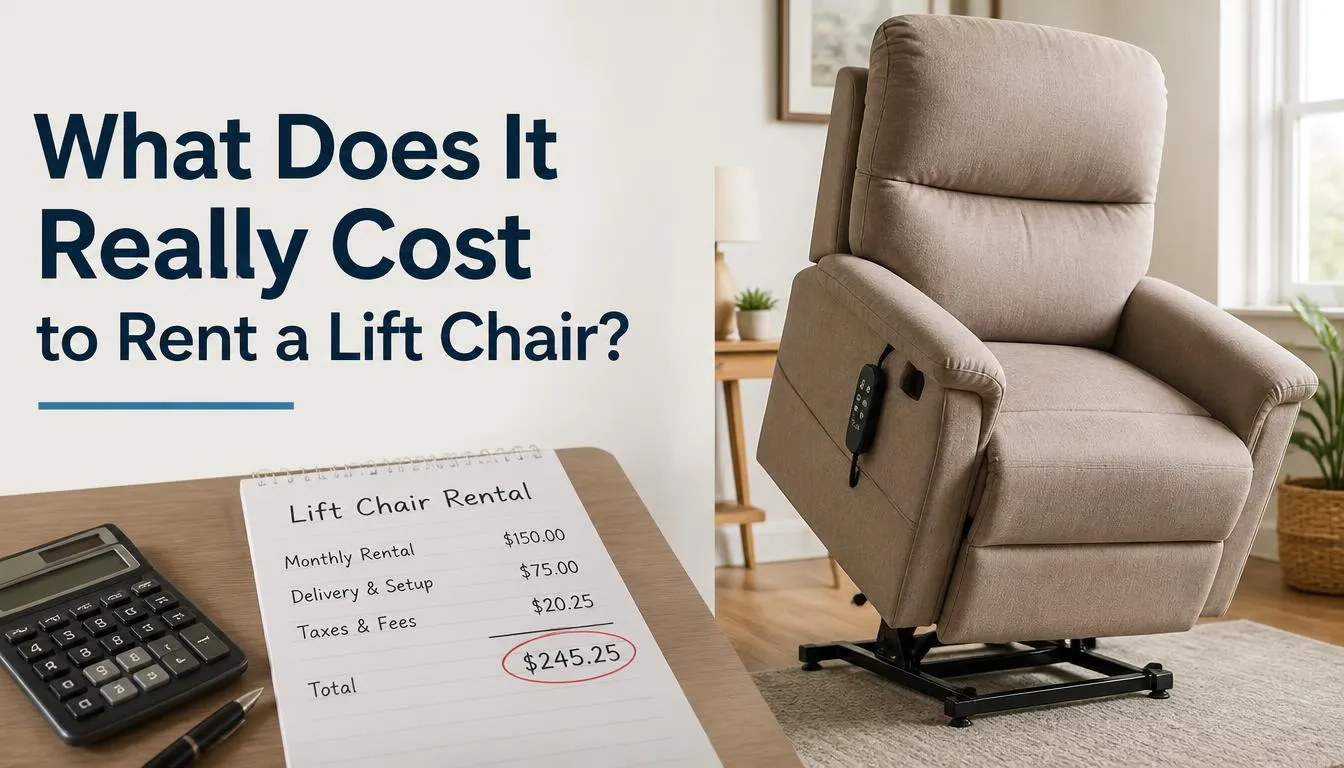

If you're asking how much it costs to rent a lift chair, the answer isn't a single number. It can be anywhere from zero dollars a month to well over $200, depending on insurance coverage, rental length, and where you live. Most people end up on the lower end if they qualify for Medicare Part B.
Others pay full retail rates because they skip insurance or need specialty chairs.
Medicare Part B typically covers 80% of the approved rental amount after you meet your annual deductible, which is $240 in 2026. That can drop your monthly out-of-pocket cost to $0, $20, but only if certain conditions are met. Let's walk through exactly what you'll pay and why the price tag changes so much from one person to the next.
Quick Answer
How much does it cost to rent a lift chair? Most people pay between $0 and $20 a month with Medicare. Without insurance, rentals run $75 to $300 monthly.
The final price hinges on coverage, location, and rental length.
The Short Answer: What You'll Likely Pay
For a basic electric lift chair rented month-to-month, expect these ranges:
- With Medicare Part B (after deductible): $0, $20/month
- With Medicare Advantage: $0, $50/month (varies by plan)
- Private insurance or supplemental plans: $20, $100/month
- Self-pay / no insurance: $75, $300/month
These numbers assume a standard 32, 40 inch wide chair with a reliable electric motor. Special orders (higher weight capacity, premium upholstery, or bariatric models) can push costs upward by 20, 40%. Read our complete guide on how much lift chairs cost if you decide to buy.
Delivery, setup, and damage deposits usually add $50, $200 one-time. Some suppliers bundle these into the monthly rate; others charge them separately. Always ask for a written cost breakdown before signing a rental agreement.
Why There's No Single Price Tag
Two people can rent the exact same chair and pay wildly different amounts. Here's why.
Insurance Coverage Drives the Biggest Split
Medicare Part B treats lift chairs as durable medical equipment (DME) when a doctor prescribes them. Private insurers and Medicare Advantage plans set their own rules, copays, and supplier networks. If you lack DME benefits entirely, you'll pay retail.
Rental Length Changes the Math
Monthly rates drop when you commit to longer terms. A 12-month rental often costs less per month than a 3-month rental because the supplier spreads delivery and admin fees over more billings. Medicare automatically transfers ownership after 13 months of continuous rental, which can be a hidden bargain.
Chair Specs and Upgrades Add Cost
Features like higher weight limits, wider seats, leather upholstery, or built-in massage can increase monthly rates by $10, $30. If comfort and ergonomics matter, exploring chairs designed for back pain relief can help you weigh costs against long-term health benefits.
Location Matters
Urban areas usually have multiple DME suppliers competing, which keeps prices down. Rural customers may face delivery surcharges or limited supplier choice. State Medicaid programs also set their own rental caps and prior-authorization rules.
Understanding Medicare Part B and DME Coverage
Medicare Part B covers lift chairs only when they meet strict DME criteria. The chair must be prescribed by a doctor, medically necessary, and used in your home. It cannot be for convenience or general comfort.
Key Medicare rules:
- You need a written order from an enrolled physician stating you have difficulty standing from a seated position and require a lift mechanism.
- The chair must be purchased or rented from a Medicare-enrolled DME supplier.
- Medicare pays 80% of the approved amount after you meet your Part B deductible ($240 in 2026).
- You're responsible for the remaining 20% coinsurance unless a Medigap policy covers it.
- After 13 continuous months of rental, Medicare transfers ownership to you.

Suppliers bid on Medicare's fee schedule, which sets maximum allowed amounts by zip code. This cap prevents suppliers from charging arbitrarily high rates to Medicare patients. Official Medicare guidelines on DME coverage are available at Medicare.gov.
When Medicare Won't Cover the Chair
- If you already own a lift chair and are renting a replacement, Medicare won't cover the new rental.
- If your doctor doesn't document medical necessity (e.g., recent hip/knee surgery, severe arthritis, balance disorder), the claim gets denied.
- If you use a supplier that doesn't accept Medicare assignment, you could owe the full retail price upfront.
How to Know If You Qualify for the Lowest Rate
Qualifying for the Medicare lowest rate comes down to three conditions.
- Doctor's prescription. Your physician must complete a Certificate of Medical Necessity (CMN) form. The form should note your diagnosis, the functional limitation (inability to rise from a regular chair), and why a lift chair is the least costly effective treatment.
- Home use. Medicare only covers DME used primarily in your residence. If you're in a nursing facility, Medicaid or facility insurance typically handles coverage instead.
- Supplier enrollment. The rental company must be enrolled in Medicare and accept assignment. You can verify a supplier's status through the CMS Provider Lookup tool.
Checklist for maximizing coverage:
- Doctor completed CMN form with ICD-10 diagnosis codes.
- Supplier is Medicare-enrolled and accepts assignment.
- You have not previously received a lift chair through Medicare.
- The chair meets minimum safety standards (look for UL listing).
If you fall short on any item, your out-of-pocket cost will rise. Consider asking your doctor about alternative treatments, such as physical therapy or a standard recliner with a lift-assist cushion, that might avoid rental altogether. Some users find that upgrading to an ergonomic office chair with proper lumbar support improves mobility and reduces the need for specialized equipment.
Breaking Down the Monthly Costs by Coverage Path
Different insurance paths produce different monthly bills. Here's a side-by-side look at what you might pay under each scenario.
| Coverage Path | Typical Monthly Cost | Out-of-Pocket Max | Ownership After |
|---|---|---|---|
| Medicare Part B (after deductible) | $0–$20 | 20% coinsurance (or 0% with Medigap) | 13 months |
| Medicare Advantage (Part C) | $0–$50 | Varies by plan (check your EOB) | Plan-specific (often 12–24 months) |
| Private health insurance (DME benefit) | $20–$100 | Copay or coinsurance per policy | Rarely transferred; usually returned |
| Supplemental Medicaid (state-based) | $0–$30 | Often $0 with full Medicaid expansion | 12–24 months depending on state |
| Self-pay / no insurance | $75–$300 | Full rental fee + deposit | Never; return at end of term |
Important notes:
- Medicare Advantage plans must cover at least what Original Medicare covers, but they can impose network restrictions and different cost-sharing.
- Some private insurers require prior authorization and may deny lift chairs if you haven't tried conservative therapies first.
- Self-pay rates vary widely. Always get at least three quotes from local DME suppliers and ask whether delivery, setup, and maintenance are included.

When comparing quotes, don't just look at the monthly rate. Ask about:
- Annual price increases (some contracts raise rates 5, 10% yearly)
- Damage waiver fees (usually $10, $25/month)
- Restocking or return shipping charges if you terminate early
- Whether the chair is replaced if it breaks down mid-rental
A slightly higher monthly rate from a reputable supplier with responsive service is often worth more than a cheap quote from a fly-by-night operation. For ongoing furniture care, learning how to repair peeling leather on a rental chair can extend its life and avoid extra fees.
The Step-by-Step Path to Getting It Covered
Getting your lift chair covered takes patience but follows a clear sequence. Follow these steps and you will avoid the most common denial reasons.
Step 1: Talk to Your Doctor First
Your physician needs to document medical necessity before anything else. Ask specifically about difficulty standing from seated positions due to conditions like arthritis, recent joint replacement, or balance disorders. The doctor must complete a Certificate of Medical Necessity (CMN) form, also called HCFA 484.
Step 2: Find a Medicare-Enrolled Supplier
Not all furniture stores sell Medicare-approved DME. Call Medicare directly or use the CMS Provider Lookup tool to find enrolled suppliers in your area. Verify they accept assignment, which means they agree to Medicare's approved amount.
Step 3: Get Your Prescription and CMN Completed
Bring the CMN form to your doctor's office. The form requires:
- Your diagnosis code (ICD-10)
- A statement that you cannot rise from a regular chair without assistance
- Confirmation that a lift chair is the least costly effective treatment
- The doctor's signature and contact information
Some suppliers provide blank CMN forms. Others want their own version. Ask which format they prefer before your appointment.
Step 4: Schedule an In-Home Measurement
The supplier will send someone to measure your space. They need to verify:
- Room dimensions fit the chair (standard widths run 32 to 40 inches)
- Electrical outlets are within cord reach
- You can safely maneuver into and out of the chair
If your home layout is tight, ask about compact models. If height is a concern, reviewing guidance on proper chair height for desk setups can help ensure the lift chair fits your living space too.
Step 5: Submit the Paperwork
The supplier handles most of the insurance submission for you. They send the CMN, product codes, and pricing to Medicare or your private insurer. You should receive an Advance Beneficiary Notice (ABN) if there is any chance coverage gets denied.
Read this notice carefully before signing.
Step 6: Receive Delivery and Setup
Delivery usually takes 1 to 3 weeks. The technician will:
- Place the chair in your chosen spot
- Plug it in and test all functions
- Show you how to operate the lift mechanism
- Explain basic care and safety guidelines
Do not sign the delivery receipt until the chair works properly and matches your order.
Step 7: Track Your Billing
Medicare sends you a Summary of Medicare Payments (SMP) every quarter. Check it to confirm the supplier billed correctly. If you see charges you did not expect, call Medicare at 1-800-MEDICARE immediately.
Renting vs. Buying: When Each Makes Sense Financially
The right choice depends on how long you need the chair and whether insurance covers it. Let us compare the two paths side by side.
When Renting Wins
Renting makes sense when:
- You need the chair for less than 12 months (post-surgery recovery, temporary injury)
- You qualify for Medicare Part B and want minimal monthly costs
- You do not want to tie up savings in a purchase
- You prefer the supplier handles repairs during the rental term
A typical self-pay rental runs $75 to $300 monthly. Over 12 months that totals $900 to $3,600. If Medicare covers 80%, your share drops to roughly $0 to $20 monthly.
That is hard to beat.
When Buying Wins
Buying makes sense when:
- You need the chair long-term (chronic mobility issues)
- You do not qualify for Medicare or insurance denies the claim
- You want a specific model, size, or feature set
- You plan to keep the chair beyond 13 months anyway
New lift chairs retail between $800 and $3,000 depending on features. Our full pricing guide breaks down exactly what you pay across different chair types. After 13 months of Medicare rental, ownership transfers to you automatically.
At that point, renting further makes no financial sense.
| Factor | Renting | Buying |
|---|---|---|
| Upfront cost | Low to zero (with insurance) | $800–$3,000+ |
| Monthly cost | $0–$300 depending on coverage | $0 after purchase |
| Ownership | Transfers after 13 months (Medicare) | Immediate |
| Repair responsibility | Supplier covers during rental | You cover after warranty |
| Best for | Short-term recovery, insurance-covered | Long-term use, denied claims |
The 13-Month Rule Matters
Medicare's rental-to-ownership threshold is a key decision point. If you rent month-to-month past 13 months, the chair becomes yours at no extra charge. Continue renting afterward only if you need a replacement model.
Otherwise, stop paying and keep the chair you already own.
Who Should Rent and Who Should Consider Buying Instead
Not everyone faces the same situation. Your health status, insurance, and timeline should drive the decision.
Rent If You Fit These Profiles
- Post-surgery patients recovering from hip or knee replacement. Most recoveries span 3 to 6 months. A short-term rental avoids a large purchase.
- Medicare beneficiaries who meet DME criteria. The $0 to $20 monthly cost is a bargain compared to retail.
- People testing tolerance for a lift chair before committing. Some users dislike the bulk or the lifting motion. Renting lets you try first.
- Fixed-income seniors who cannot afford a $1,500 upfront cost. Monthly billing spreads the expense.
Buy If You Fit These Profiles
- Chronic condition sufferers who need lifelong support. Monthly rentals add up over years.
- Denied claims who cannot get insurance coverage. Self-paying a one-time purchase often beats years of rental fees.
- Specific geometry needs like bariatric models (400+ lb capacity) or extra-wide seats. Insurance may not cover premium options.
- Homeowners planning to stay long-term. Buying increases property functionality without ongoing bills.
Hybrid Option: Rent Then Buy
Some suppliers offer rent-to-own programs. You pay monthly with a portion applying toward purchase. These programs often have higher total costs than straight rental through Medicare.
Read the contract carefully before signing. Look for:
- Total price cap (should not exceed 150% of retail)
- Early payoff options
- Whether maintenance is included
If durability matters throughout this process, checking reviews on long-lasting seating options can help inform your broader furniture decisions too.
Hidden Fees and Common Rental Mistakes to Avoid
Suppliers make money on fees you do not expect. Knowing them upfront saves you surprises.
Fees to Watch For
| Fee Type | Typical Cost | What to Ask |
|---|---|---|
| Delivery surcharge | $50–$150 | Is it included in the monthly rate? |
| Setup fee | $75–$200 | Do they test the chair in my home? |
| Damage deposit | $50–$200 | Is it refundable? What counts as damage? |
| Damage waiver | $10–$25/month | Does it cover accidental tears or burns? |
| Early termination fee | 20–50% of remaining payments | Can I switch to buying out early? |
| Return shipping | $100–$300 | Do I arrange pickup or drop-off? |
Common Mistakes That Cost Money
- Skipping the in-home measurement. Ordering the wrong size means re-delivery fees or a different chair you do not need.
- Ignoring the ABN. If Medicare might deny coverage, the supplier must give you a notice. Signing without reading it means you owe the full bill.
- Not inspecting on delivery. Accepting a scratched or malfunctioning chair traps you. Report issues before the technician leaves.
- Mishandling during the rental. Spills, burns, or broken mechanisms usually trigger repair bills. Learning basic leather care can prevent costly damage claims.
- Waiting until the last minute to return. Late returns often incur extra monthly charges. Schedule pickup at least 7 days before your term ends.
Red Flags in Rental Contracts
Walk away if you see:
- Verbal promises not written in the agreement
- Automatic renewal clauses with no cancellation window
- Vague damage definitions that let the supplier charge arbitrarily
- No mention of Medicare billing or supplier enrollment number
Always get everything in writing. A reputable DME supplier answers questions transparently and provides copies of all paperwork.
Maintaining Your Rental Chair During the Term
Proper upkeep keeps the chair safe and helps you avoid damage fees at return time.
Weekly Care
- Vacuum upholstery to remove crumbs and dust
- Wipe surfaces with a damp cloth (never soak fabric)
- Check that the lift mechanism moves smoothly without grinding noises
- Inspect cords and plugs for fraying or exposed wires
Monthly Checks
- Test the emergency lower function (usually a lever or button near the base)
- Tighten any loose screws on armrests or panels
- Look for wear patterns on high-touch areas like armrest edges
- Confirm the chair levels on your floor (adjust feet if needed)
What to Do If Something Breaks
Contact your supplier immediately. Most rental agreements cover repairs during the term. Do not attempt DIY fixes on the lift motor or electrical components.
Voiding the warranty shifts repair costs to you.
Preparing for Return
Before your rental ends:
- Clean the chair thoroughly (some contracts require professional cleaning)
- Remove all personal items and attachments
- Pack original packaging if you kept it
- Schedule pickup 1 week early to avoid late fees
Ask for a final inspection checklist so you know exactly what the supplier will examine. If you end up keeping an older chair instead, understanding how long office chairs typically last can help you gauge whether yours has further life left.
Frequently Asked Questions
How long does Medicare cover a lift chair rental?
Medicare covers lift chair rentals for up to 13 continuous months. After that period, ownership automatically transfers to you. You stop paying monthly rental fees once the 13th month ends.
If you need a different chair before then, you must start a new rental agreement with new documentation.
Can I use my own lift chair with Medicare?
No. Medicare will not cover rentals if you already own a lift chair. It only pays for new equipment when medically necessary.
You can keep your existing chair and rent another one, but Medicare will deny coverage for the second chair unless you can prove you no longer have access to your original one.
What happens if the rental chair breaks down?
Your supplier is responsible for repairs during the rental term. Contact them immediately when a problem appears. Do not attempt fixes yourself.
If the chair cannot be repaired within a reasonable time, request a replacement unit. Most contracts include maintenance coverage; read your agreement carefully to confirm.
Do I need a prescription for a rental lift chair?
Yes. Medicare requires a written order from a physician along with a Certificate of Medical Necessity (CMN). Private insurers usually require similar documentation.
Without a doctor's prescription stating you cannot rise from a regular chair, the claim will likely be denied regardless of your condition.
Can I return a rental chair early without penalty?
Early termination fees vary by supplier and contract. Some charge 20% to 50% of remaining payments. Others allow cancellation with 30 days' notice and a small processing fee.
Always ask about early exit terms before signing. If Medicare covers the chair, you generally cannot cancel mid-rental because ownership transfers at month 13.
Are there tax deductions for rental lift chairs?
You may be able to deduct medical expenses on Schedule A if they exceed 7.5% of your adjusted gross income. Keep records of all rental payments and related costs. Consult a tax professional to determine what qualifies under current IRS rules.
Your Next Move: A Quick Decision Guide
You now have the numbers and the process. Here is how to decide what to do next.
Step 1: Check Your Eligibility First
Before calling suppliers, confirm whether you qualify for Medicare DME coverage. Gather:
- Your Medicare number and group information
- A list of current medications and diagnoses
- Names of all treating physicians
- Your home address and primary care provider details
If you have Medicare Advantage, call the member services number on your card and ask about DME benefits. Note any required copays and in-network suppliers.
Step 2: Decide Between Renting and Buying
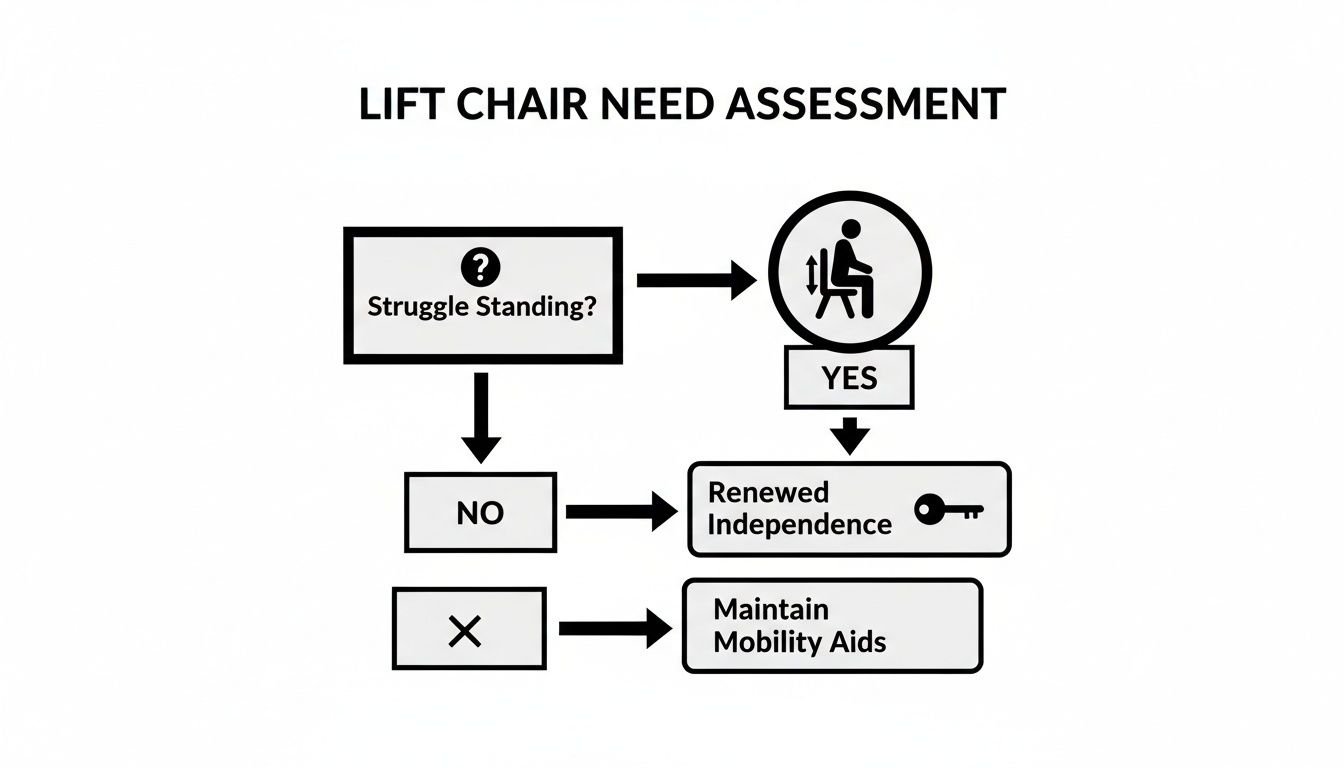
Use this simple decision tree:
Do you have Medicare Part B and meet medical necessity criteria? Yes → Rent through Medicare. Expect $0, $20 monthly.
Do you need the chair for less than 12 months? Yes → Rent, even without insurance. Compare self-pay quotes from at least three suppliers.
Have you been denied Medicare coverage? Yes → Buy a chair outright. Our pricing guide shows typical retail costs so you can budget accordingly.
Do you need a specialty size (bariatric, extra wide)? Yes → Rent first to ensure fit, then consider purchasing if long-term use is certain.
Step 3: Choose the Right Supplier
When you have quotes in hand, evaluate suppliers using these criteria:
- Medicare enrollment verified via CMS lookup tool
- Clear breakdown of all fees (delivery, setup, deposit)
- Written warranty covering motor and mechanism for at least 1 year
- Responsive customer service (check Better Business Bureau ratings)
- Willingness to provide references from recent customers
Do not choose based on price alone. A cheap supplier with poor service can leave you stranded when repairs are needed.
Step 4: Prepare Your Home Before Delivery
Measure your space carefully. A standard lift chair needs:
- Width clearance of at least 3 inches on each side
- Wall-recliner models require 10, 12 inches from the wall
- Easy access to a grounded electrical outlet
- Level flooring that can support 300+ pounds
Consider ergonomic seating solutions that improve posture and reduce strain while you wait for delivery.
Step 5: Complete the Paperwork Correctly
Bring your CMN form and Medicare card to the supplier. Double-check that:
- All diagnosis codes match your medical records
- The chair model matches what your doctor prescribed
- Delivery date is scheduled and confirmed
- You receive a copy of every signed document
Ask for a detailed invoice showing monthly charges, deductible responsibility, and coinsurance amounts. Keep these records for tax purposes if you itemize deductions.
Final Checklist Before Signing
- Supplier accepts Medicare assignment
- No hidden fees in the contract
- Delivery included in the quoted price
- Repair service clearly outlined
- Return policy stated in writing
- Emergency lower function demonstrated
Take your time. A lift chair is a significant investment of money and health. Make sure the terms protect you before you commit.