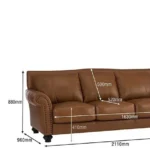
You keep seeing "transitional" on sofa tags, but the picture in your head stays fuzzy. What is a transitional sofa? It's the piece that sits between traditional and contemporary, borrowing from both without committing to either.
That's exactly why it's so easy to live with.
Here's a useful anchor before we go further. Most three-seat versions run 72 to 96 inches wide, with seat height around 18 to 20 inches. Foam and frames also have to clear California TB117-2013 flammability rules, so part of the deal is already regulated.
Let's start with what the style actually is.
What Is a Transitional Sofa?
A transitional sofa blends traditional and contemporary design into one piece. It keeps classic comfort with cleaner, quieter lines. Think neutral fabric, soft curves, and simple wood legs.
It fits almost any room without looking stuck in one era. That flexibility is the whole point.
Designers treat transitional as a range, not a rulebook. Some versions lean warm and padded, close to the rolled-arm classics your parents had. Others go flatter and tighter, nearer to quieter contemporary lines.
The balance is the trick. Traditional proportions and deep comfort stay. Carved wood, skirted bases, and heavy print go.
Texture takes the place of ornament.
So when a showroom calls something transitional, check the bones. Neutral fabric alone doesn't make it transitional. The mix of old-school comfort and modern restraint does.
Key Features That Define the Transitional Look
Restraint is the signature. Nothing on the sofa is trying to be the loudest thing in the room.
Here's what to look for:
- Neutral, layered color. Greige, oatmeal, taupe, warm grey, soft cream.
- Softened geometry. A straight base with gently curved or slightly flared arms.
- Arms that split the difference. A slimmed roll, or a track arm with a rounded top edge.
- Simple legs. Tapered wood in oak or walnut tones, sometimes capped in brass.
- Quiet back. Tight back, or one bench cushion instead of three fussy ones.
- Low-contrast texture. Linen blends, chenille, performance weave, top-grain leather.
- Minimal ornament. A single welt line at most. No nailhead rows, no carved apron.
Fabric numbers matter more than the fabric name. For everyday family use, look for 15,000 or more double rubs on the Wyzenbeek scale set out in ASTM D4157, a standard published by ASTM International. Push past 30,000 if you've got kids and a dog.
Not sure which part is the arm and which is the frame? Our rundown of arms, legs and frames sorts that out.

Image source: Openverse / Wonderlane
How It Compares to Traditional and Contemporary Sofas
Transitional is the midpoint, and that's the whole idea.
| Detail | Traditional | Transitional | Contemporary |
|---|---|---|---|
| Arms | Rolled, padded, generous | Slimmed roll or soft track | Sharp, squared, low |
| Legs | Turned dark wood | Tapered light or mid wood | Metal or hidden plinth |
| Color | Jewel tones, prints | Neutrals plus texture | Monochrome, bold solids |
| Ornament | Tufting, nailheads, skirts | One welt line | Seams only |
| Feel | Formal, heirloom | Relaxed but tidy | Cool, minimal |
Who's each one for? Traditional suits you if you want a room that reads collected and slightly formal. Contemporary fits if you like gallery-clean lines with nothing extra.
Transitional is for people who like both and refuse to pick.
If you want more edge than transitional offers, the sharper modern shapes are worth a look.
As of 2026, most transitional lines still ship in neutral performance weaves. That's why they wear well and photograph well.
Ideal Situations and Who Benefits Most from a Transitional Sofa
It's the safest pick when your taste hasn't fully settled yet.
Where it earns its keep:
- Open-plan rooms, where one style has to work across several zones.
- Homes mixing inherited pieces with new purchases.
- First apartments, where you'll probably move again in three years.
- Rentals, since you can't repaint the walls or swap the floors.
- Home staging, because broad appeal sells faster.
If you're choosing a centerpiece for the main room, our guide to picking the right lounge couch narrows it down.
Sizing is where most people slip. Leave about 18 inches between the sofa front and the coffee table so knees clear it. Keep walkways at 30 to 36 inches.
Measure twice, then check our notes on standard sofa measurements.
Busy household? Choose performance fabric over linen. Linen looks lovely and wrinkles the moment someone sits down.
Common Pitfalls and How to Avoid Them
Most regrets trace back to four avoidable mistakes.
- Buying from a photo. Always read the cleaning code first: W is water-based, S is solvent only, WS takes both, X means vacuum only.
- Ignoring scale. A 96-inch sofa swallows an 11-by-12-foot room. Go 78 to 84 inches instead.
- Skipping the delivery route. Measure doorways, hallways, and stair turns. Getting a big sofa inside is harder than it sounds, and doorway measurements save the day.
- Choosing a delicate weave for rough use. Blends and performance fabrics survive; open-weave linen doesn't.
Why does a transitional sofa sometimes look bland?
Because it's usually under-styled, not under-designed. The clean lines need one anchor. Add a darker rug, a textured throw, and two pillows in a deeper tone.
That's enough.
One more thing. Anchor the sofa or any heavy case goods to a wall, per Consumer Product Safety Commission tip-over guidance. Kids climb.
Brackets are cheap.
Pricing, Specs, and Buying Guide
Transitional sofas span a wide price band because the style appears at many price points. Budget-focused retailers often offer transitional looks for $600 to $900, usually in engineered wood frames and blended fabrics. Mid-range options sit between $1,200 and $2,200, featuring kiln-dried hardwood frames, eight-way hand-tied coil springs, and performance-grade upholstery.
Premium brands list $2,500 to $3,500+, solidifying joinery, top-grain leather, or custom fabric sourcing.
Standard dimensions stay consistent across the category. Most three-seat transitional sofas measure 72 to 96 inches wide, with seat depth ranging 22 to 24 inches and seat height 18 to 20 inches. Depth variations matter more than width for comfort; a 40-inch depth offers deeper seating, while 35 inches feels firmer.
Always verify frame joinery, double-dowel or mortise-and-tenon construction outlasts cam-lock assembly by years.
Fabric performance numbers help narrow choices. The Wyzenbeek abrasion test, referenced in ASTM D4157, rates fabric durability. For daily family use, select 15,000 double rubs minimum.
Households with children and pets should target 30,000+. If the tag only lists a brand name without a rub count, assume moderate durability and plan to rotate cushions regularly.
Delivery logistics often surprise first-time buyers. Many online brands ship in two boxes; confirm whether inside-room placement is included or if extra fees apply. Some retailers offer white-glove assembly for $150 to $300.
Always measure doorways and hallways before ordering, standard sofa heights of 34 to 38 inches can catch on stair railings. Our guide to doorway measurements walks through the checkpoints.
Expert Styling and Maintenance Tips
A transitional sofa reads cleanest when balanced with texture, not pattern. Layer a jute or wool rug underneath to ground the piece; a solid neutral rug makes the sofa pop, while a subtle pattern adds visual interest without competing. Two pillows in a deeper tone, navy, charcoal, or forest green, create focal points.
A folded throw at the arm's end adds drape and softness.
Fabric care depends on the cleaning code sewn into the bottom cushion. W-code cushions accept water-based cleaners; S-code requires solvent-only spot treatment. WS-code takes both, making it the most forgiving for household spills.
X-code means vacuum only, no liquids. Always test any cleaner on an hidden seam first. For performance weaves, a microfiber cloth and mild soap handle most marks.
Linen blends benefit from gentle brushing to restore nap.
Rotating cushions every three months distributes wear evenly, especially on sofas with loose-back construction. If the sofa sits in direct sunlight, fade-resistant fabrics last longer. Rotate the piece seasonally if possible, or use sheer curtains to diffuse harsh rays.
Our sourcing notes on performance fabrics explain why weave tightness matters for sun exposure.
Anchoring the sofa to wall studs adds safety, particularly in homes with small children. Brackets cost under $20 and install in under fifteen minutes. Check the Consumer Product Safety Commission for tip-over prevention guidelines.
A stable sofa feels more solid over time, and the hardware hides behind the dust ruffle or throw.
Frequently Asked Questions
What defines a truly transitional sofa versus just a neutral one?
A transitional sofa balances traditional comfort with contemporary restraint. Neutral color alone doesn't make it transitional, the mix of softened lines, mixed materials, and proportion matters. Look for the style signals: curved arms, tapered legs, and minimal ornament.
Can a transitional sofa work in a small apartment?
Yes. The style's flexibility means it won't read as too formal or too stark in compact spaces. Choose a two-seat or love seat scale, and keep the silhouette low-profile.
Our standard sofa dimensions post outlines exact measurements for small rooms.
Is a transitional sofa a good investment for resale?
Transitional pieces typically appeal to the broadest buyer pool, which can aid resale. Because the style avoids strong trend signals, it ages better than trend-driven designs. Price retention depends more on condition and fabric quality than the style label itself.
What's the best fabric for a transitional sofa in a home with dogs?
Performance weaves rated 30,000+ double rubs handle pet claws best. Tightly woven synthetic blends resist snagging more than open-weave linens. Leather also resists pet hair but scratches more visibly.
Our pet-friendly fabric guide compares options in detail.
Do transitional sofas come in sectionals?
Yes, many brands offer transitional-style sectionals. The same design language, neutral palette, softened arms, tapered legs, applies. Sectional configurations vary by manufacturer, so measure your room and check return policies before ordering online.