You are six foot three and tired of feeling like a folded map in your office chair. Most chairs were designed for people under five eleven. That leaves you with dangling legs, neck strain, and lower back pain that builds up by mid-afternoon.
Finding the best office chair for tall person comfort is not about browsing top sellers on Amazon. It is about understanding the exact measurements that separate a chair that fits from one that slowly damages your posture.
Standard office chairs often bottom out at a seat height of twenty inches and a backrest that stops at your shoulders. Per ergonomic industry guidelines, a proper task chair for someone over six feet should accommodate a seat depth of at least nineteen inches and a height range that keeps your feet flat without compressing behind your knees. Let us walk through exactly what to measure, what to test, and which chairs actually clear those thresholds.
Why Most Office Chairs Fail Tall People (And What Actually Works)
Image source: Bing (Web (fair-use with source credit))
The average American man now measures around five foot nine. That number shapes how furniture companies design their products. A standard office chair assumes a torso length of roughly thirty inches and leg length under thirty-four inches.
If you stand six foot two or taller, those assumptions leave critical gaps in your support system.
Your thighs likely press against the front edge of the seat pan. That pressure cuts off circulation and creates numbness within an hour. Your feet probably hover above the floor unless you crank the gas lift to its absolute maximum.
Even then, your knees sit higher than your hips, which forces your pelvis into a posterior tilt. Your spine compensates by rounding forward. Hours later, your lower back aches and your shoulders hike toward your ears.
Most chairs fail tall users on three specific dimensions: seat depth, backrest height, and weight distribution geometry. Seat pans shorter than eighteen inches simply cannot span a longer thigh. Backrests that end below the shoulder blade leave your upper back and neck floating unsupported.
The center of gravity in a short chair sits too low for a long-legged occupant, creating a tipping sensation that makes you lean forward preemptively. That forward lean is exactly what ergonomic seating aims to prevent.
The chairs that work for tall people share one trait: they were engineered with adjustable geometry rather than fixed proportions. Features like a sliding seat pan, a backrest extending past the shoulders, and armrests that travel both up and down create a customizable envelope. You dial each adjustment until your body aligns naturally.
Your feet rest flat. Your thighs distribute weight evenly. Your spine maintains its natural curves without muscular effort.
Choosing the right chair matters just as much as choosing the right desk setup for tall users because mismatched furniture creates compounding postural stress throughout the day. When your chair underperforms, your desk height becomes irrelevant. The foundation has to be correct before you layer in other ergonomic solutions.
The Quick Answer: What to Look For Before You Browse
The best office chair for tall person sitting features a seat depth of at least nineteen inches, a backrest that reaches your upper shoulders, a seat height range spanning sixteen to twenty-two inches, and armrests adjustable across height, width, and depth axes. Priority models include the Herman Miller Aeron in Size C, the Steelcase Leap V2, and the Autonomous ErgoChair Ultra for mid-range budgets. Always verify the manufacturer's stated height and weight ratings before purchasing.
Chair fit depends on your specific measurements, not your shoe size or general build. A tall person with a long torso needs different proportions than one with longer legs and a shorter spine. Measure your inseam, your seat-to-shoulder distance, and your current chair's dimensions if it causes discomfort.
Those numbers become your baseline for comparison shopping.
A proper ergonomic chair costs between four hundred and one thousand eight hundred dollars as of 2026. Budget options under three hundred dollars rarely accommodate heights above six feet one inch. That does not mean you must spend a fortune, but it does mean compromising on adjustability in the lower price tiers.
We cover real budget-friendly options later in this guide.
Now let us move into the exact measurements that determine whether a chair will work for you or waste your money.
Key Measurements That Define a Chair for Tall Users
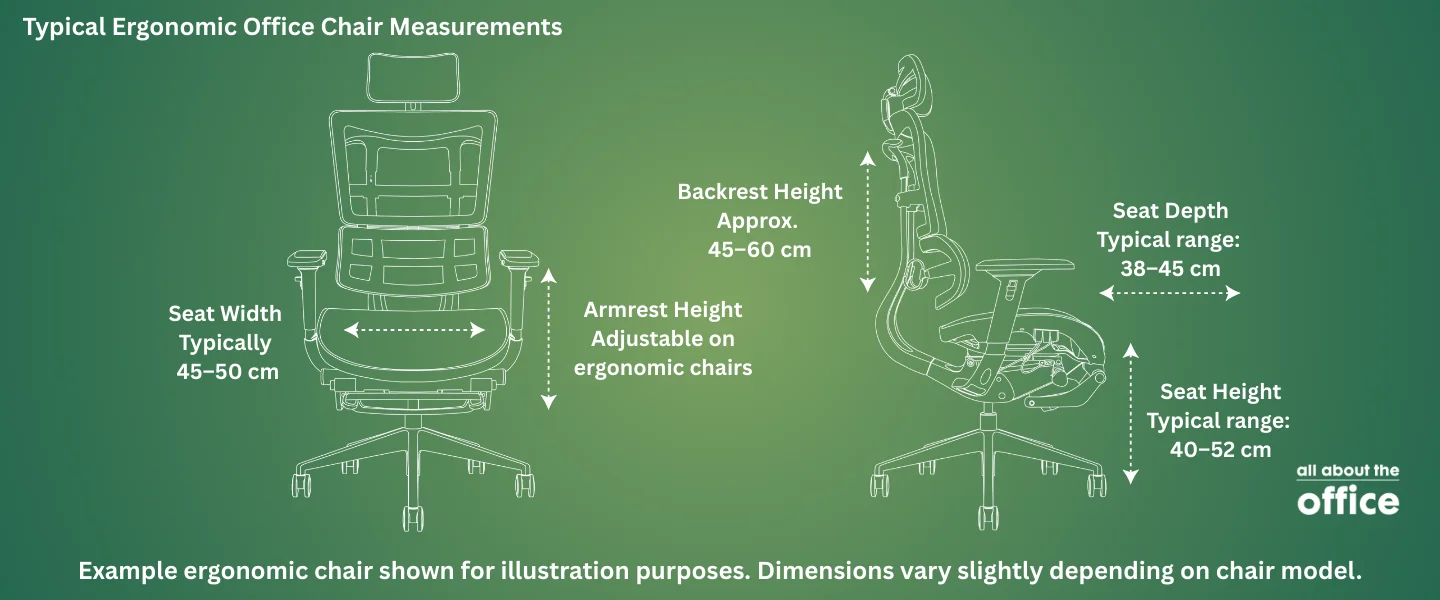
Image source: Bing (Web (fair-use with source credit))
Understanding chair dimensions removes the guesswork from online shopping. You can read a spec sheet and immediately spot whether a chair matches your body. Four measurements matter most for tall users.
Every other feature branches from these fundamentals.
Seat Depth: The Non-Negotiable Metric
Seat depth measures from the front edge of the seat pan to the backrest contact point. For someone six foot two and taller, you need a minimum of nineteen inches. Ideal range sits between nineteen and twenty-one inches.
Anything less creates the thigh-compression problem we discussed earlier.
This measurement matters as much as proper lumbar support when addressing back pain from extended sitting. A shallow seat forces you to sit on the edge, which eliminates lumbar contact and shifts your entire weight onto your tailbone. You feel fine for thirty minutes.
By hour three, your lower back cramps and your hamstrings tighten from the altered pelvic angle.
The Herman Miller Aeron in Size C delivers a seat depth of approximately twenty inches. The Steelcase Gesture offers around eighteen point seven inches but includes a slide mechanism that extends it further when needed. Some budget brands list seat depth inaccurately or measure from the wrong reference point.
Always confirm whether a manufacturer measures from the front edge of the cushion or from the frame underneath.
Backrest Height and Shoulder Support
Backrest height determines whether your entire spine receives contact support. For tall users, the backrest must extend to at least your third thoracic vertebra. That lands roughly four to six inches below the base of your skull when seated.
Backrests ending at the shoulder blades leave your upper back and neck floating unsupported.
Many mid-range chairs advertise high backs but stop at eighteen inches from the seat plane. A person six foot four needs twenty-two inches or more of vertical backrest coverage. The difference shows up quickly during any task requiring leaning back, whether you are reviewing documents on a monitor or taking a phone call.
Without upper back contact, your neck muscles fire continuously to hold your head position. Fatigue follows.
The Steelcase Leap V2 features a LiveBack flex backrest that adjusts to your spine shape. Its total backrest height reaches approximately twenty-six inches from the seat, which covers the full spinal column for users up to six foot eight. The Herman Miller Mirra 2 offers similar full-length coverage with a slightly different flex pattern.
These designs matter when you spend eight or more hours seated daily.
Seat Height Range and Weight Capacity
Seat height range defines how far the chair lifts you from the floor. Standard chairs typically adjust between sixteen and twenty inches. Tall users often need seventeen to twenty-two inches to achieve proper knee angle and foot placement.
A chair that tops out at twenty inches forces you to raise your desk instead, which creates wrist and shoulder strain at the keyboard.
Weight capacity runs parallel to seat height because taller frames often carry more mass. Many chairs rated for two hundred fifty pounds use smaller gas cylinders that cannot safely support heavier loads at extended heights. A six foot four person weighing two hundred ten pounds might exceed the safe operating range of a chair rated two hundred fifty pounds at maximum height extension.
Manufacturers rate weight capacity based on cycle testing per BIFMA standards. Those tests simulate years of use under specified loads. Exceeding the rated capacity voids warranties and creates safety risks including cylinder failure and base collapse.
Always choose a chair with a weight rating at least twenty-five pounds above your actual body weight. That margin accounts for dynamic movement and long-term cylinder wear.
Armrest Adjustability for Long Arms
Armrests that only adjust vertically frustrate tall users because longer arms require wider positioning too. Four-dimensional armrests adjust height, width, depth, and pivot angle independently. This lets you position your arms at a ninety-degree elbow angle while keeping your shoulders relaxed and down.
Two-dimensional armrests only move up and down. Three-dimensional versions add forward and backward travel. Four-dimensional setups are the gold standard for tall users who need to widen the armrest spread to match shoulder breadth without raising them into their armpits.
The Herman Miller Aeron includes width-adjustable armrests as standard. Its pivot function allows the pads to angle inward or outward. The Steelcase Leap V2 offers four-way adjustment with a generous width range that accommodates broader shoulder spans common in taller frames.
Budget chairs rarely exceed two-axis armrest movement, which limits comfort for extended use.
Top Pick for Premium Ergonomics: Herman Miller Aeron (Size C)
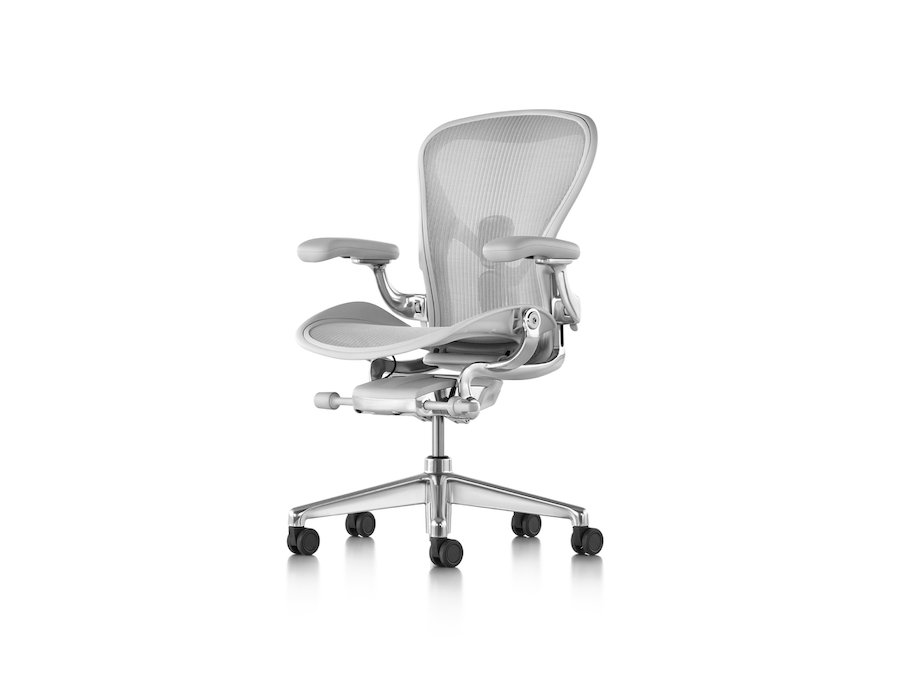
Image source: Bing (Web (fair-use with source credit))
The Herman Miller Aeron in Size C remains the benchmark for premium ergonomic seating among tall professionals. Released originally in 1994 and refined through multiple generations, this chair combines a proprietary suspension mesh system with a comprehensive adjustment suite designed for diverse body types. Size C specifically targets users five foot ten to six foot six.
Why It Works for Tall Frames
The Aeron Size C features a twenty-inch seat pan depth, which eliminates thigh compression for most users over six feet. The PostureFit SL lumbar system provides independent sacral and lumbar support that adapts as you shift positions throughout the day. The tilt mechanism includes forward tilt capability for focused work at the desk and recline tension adjustment calibrated to your body weight.
The fully suspended Pellicle mesh distributes pressure across your entire seated surface. Unlike foam cushions that create hot spots and lose resilience over time, mesh maintains consistent support regardless of sitting duration. The breathable construction also keeps you cool during long work sessions, a genuine advantage in warm offices or homes without climate control.
Armrests on the fully adjustable model move in four directions: height, width, depth, and pivot. The wide width range accommodates broader shoulders without forcing your elbows inward. This matters more than people realize because incorrect armrest positioning directly contributes to upper trapezius tension and cervical strain.
Pros and Cons for 6'2"+ Users
The Aeron excels in several areas that matter most to tall sitters:
- Seat depth eliminates leg circulation issues common with shorter pans
- Backrest height covers the full spinal column including thoracic and cervical regions
- Mesh breathability reduces heat buildup during extended sitting periods
- Ten-year warranty covers all mechanisms and structural components
- Resale value retention outperforms nearly every competitor in the category
- Forward tilt supports aggressive desk work without losing lumbar engagement
The Aeron also carries notable limitations for tall users:
- Size C tops out comfortably around six foot six. Taller users may find the backrest insufficient
- The mesh firmness feels stiff to users preferring plush cushioning
- Armrests lack palm rest attachments as standard equipment
- At current pricing, the Aeron represents a significant investment requiring justification
- Some users report the tilt mechanism feels overly resistant without tension calibration
- The iconic design attracts attention in meeting rooms, which some prefer and others find distracting
Who It's Best For
The Aeron Size C suits tall professionals spending eight or more hours daily at a desk. It works exceptionally well for software developers, writers, analysts, and remote workers who treat their chair as primary work infrastructure. If you already struggle with lower back discomfort from sitting, the proper lumbar and seat depth combination found here addresses many root causes.
The PostureFit system engages both the lumbar curve and the sacral region, which most single-point lumbar supports miss entirely.
Users who prefer a firmer seating surface and excellent breathability will appreciate the mesh construction. Those who sink into soft upholstery may find the Aeron uncomfortably rigid. The chair rewards users willing to invest time in initial adjustment calibration.
Once dialed in correctly, it requires minimal readjustment across months of daily use.
Top Pick for Total Adjustability: Steelcase Leap V2
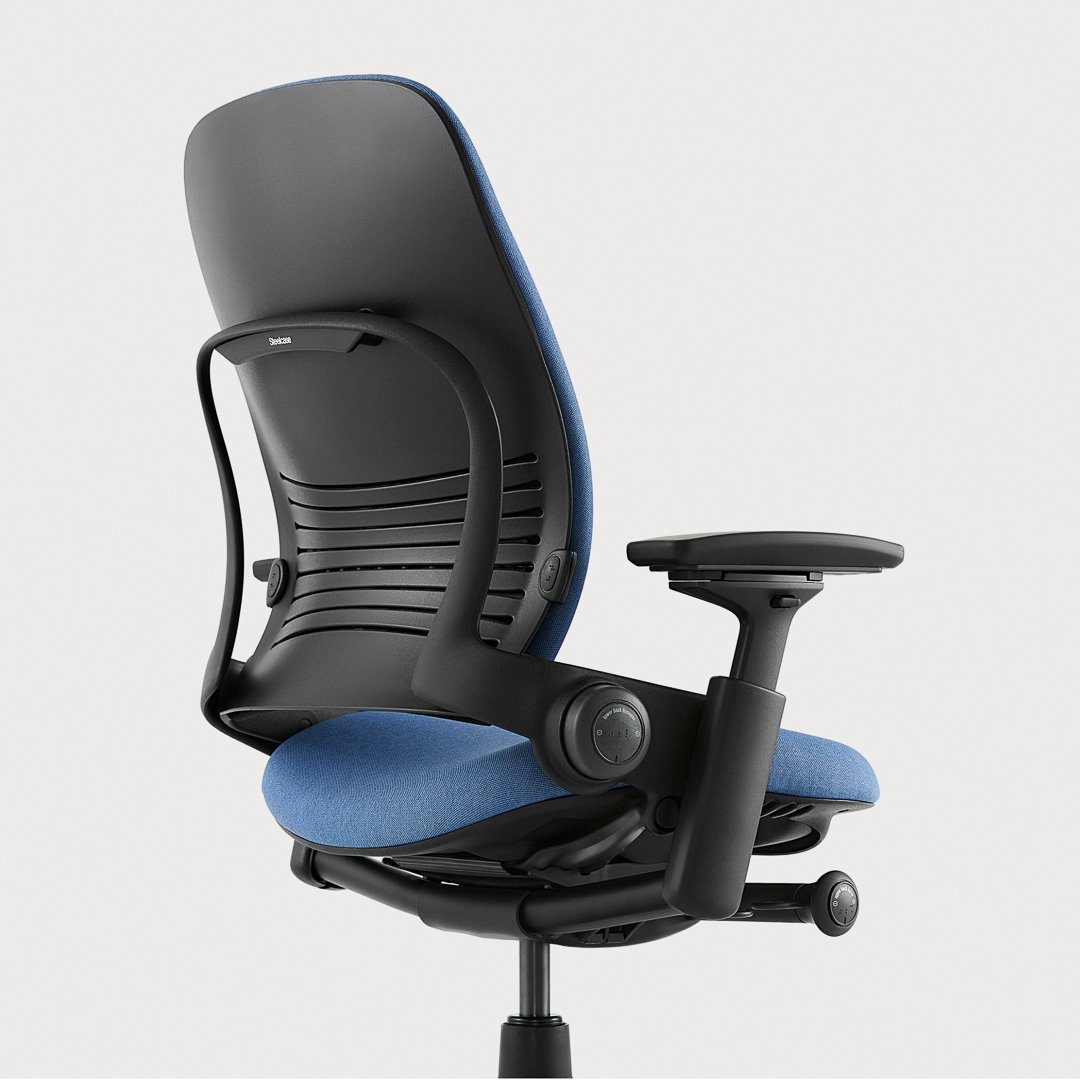
Image source: Bing (Web (fair-use with source credit))
The Steelcase Leap V2 earns its reputation through unmatched adaptability across body types and sitting styles. Where the Aeron prioritizes suspension and breathability, the Leap V2 prioritizes customizable contact points along your entire spine. Both chairs serve tall users excellently.
Both arrive at that conclusion through different engineering philosophies.
How Its LiveBack Technology Adapts to Taller Spines
Steelcase developed LiveBack technology based on research mapping how human spines change shape across different postures. A rigid backrest forces your spine to conform to the chair. A flexible backrest allows your spine to maintain its natural curves regardless of position.
The Leap V2 backrest mimics the curvature of a healthy human spine and adjusts its support point dynamically as you recline.
The adjustable lumbar support travels vertically across a three-inch range. This lets you position the lumbar node precisely at your lower back's natural curve. Standard fixed lumbar pads sit at one height and expect everyone to match them.
Taller users with longer torsos frequently find factory-set lumbar nodes pressing too high or too low against their spines. The Leap V2 eliminates that guesswork.
Seat depth adjustment slides the pan forward or backward in half-inch increments. This feature addresses the variability in thigh length that height alone does not predict. Two people standing six foot four may have significantly different leg-to-torso ratios.
The adjustable seat depth accommodates both without compromise.
Pros and Cons for Extended Sitting
The Leap V2 delivers distinct advantages for tall daily sitters:
- LiveBack technology responds to spinal movement throughout the day without manual adjustment
- Vertical lumbar travel accommodates varying torso lengths across the same height range
- Natural glide system tilts your thighs upward during recline, reducing pressure behind the knees
- Four-way armrests with wide spread range suit broad-shouldered tall frames
- Upholstered cushion options provide softer contact than mesh alternatives
- Twelve-year warranty covers all mechanical components and structural integrity
The Leap V2 presents trade-offs worth considering:
- The upholstered backrest traps more heat than mesh construction during summer months
- Maximum seat depth extension reaches approximately twenty inches, which suffices for most but not all tall users
- The Natural Glide system requires a learning period before recline feels intuitive
- At comparable pricing to the Aeron, the value proposition depends on personal preference for cushion versus mesh
- Armrest padding durability shows wear patterns faster than the frame and mechanism
- The chair's visual profile leans toward corporate aesthetics rather than modern minimalist design
Who It's Best For
The Leap V2 appeals to tall users who prioritize adaptive support over static positioning. If your posture changes frequently throughout the day, the LiveBack system adjusts without requiring you to stop and recalibrate. The cushion options suit users sensitive to firm surfaces or those who prefer the conforming feel of high-density foam over suspended mesh.
Office environments favoring traditional upholstered aesthetics over industrial mesh designs find the Leap V2 a seamless fit. The chair performs equally well in executive offices and open-plan workspaces. Its adjustment complexity pays dividends for users willing to spend ten minutes dialing in their settings on day one.
Best Mid-Range Options That Don't Compromise on Fit
The space between budget and premium chairs contains several genuinely capable options for tall users. These models sacrifice some adjustment ranges or material quality compared to the Aeron and Leap V2, but they deliver solid ergonomic performance at prices between four hundred and eight hundred dollars. Several require closer scrutiny regarding seat depth and backrest height specifications.
Autonomous ErgoChair Ultra Review
The Autonomous ErgoChair Ultra targets the mid-range market with an aggressive feature set. It offers a breathable mesh back, adjustable lumbar support, and a recline mechanism with multiple lock positions. The headrest option adds cervical support for users who frequently recline during calls or reading tasks.
Seat depth on the ErgoChair Ultra measures approximately nineteen inches, which clears the minimum threshold for most tall users. The seat height range extends from sixteen to twenty inches, accommodating inseams up to approximately forty inches. Users taller than six foot four may find the maximum seat height marginal for desk compatibility depending on their individual proportions.
Build quality holds up reasonably well over two to three years of daily use. The mesh tension maintains its initial firmness better than some competitors in this price tier. The adjustable lumbar pad provides adequate lower back support though it lacks the dual-zone engagement of the Herman Miller PostureFit system.
Armrests adjust in three dimensions: height, width, and depth. Pivot functionality is absent.
The ErgoChair Ultra works well for tall users seeking mesh construction and headrest support without premium pricing. Its primary limitation is backrest height, which reaches approximately twenty-four inches from the seat. Users over six foot six may experience shoulder-level support gaps during full recline positions.
Branch Ergonomic Chair Assessment
Branch positions itself as a direct-to-consumer brand offering quality materials at transparent pricing. The Ergonomic Chair features a molded mesh back, adjustable lumbar cushion, and a synchro-tilt mechanism with tension control. The seat pan measures approximately eighteen point five inches in depth, which falls just below the ideal nineteen-inch threshold for taller users.
The chair accommodates heights up to six foot two comfortably. Taller users will experience mild thigh compression at extended sitting durations. The backrest extends to approximately twenty-three inches from the seat, covering the lumbar and most of the thoracic region.
Upper back support during recline remains partial rather than complete.
Build quality impresses relative to the price point. The aluminum base and reinforced nylon frame suggest reasonable durability for three to five years of typical use. Assembly takes approximately twenty minutes with included tools.
Branch offers a two-year warranty covering manufacturing defects, which is adequate but notably shorter than the decade-scale coverage from premium brands.
The Ergonomic Chair suits tall users under six foot three who prioritize clean design and straightforward operation over maximum adjustability. It works well as a home office centerpiece where aesthetics matter alongside function.
HON Ignition 2.0 for Durable Daily Use
HON brings industrial-grade durability to the mid-range segment with the Ignition 2.0. This chair targets high-volume environments where furniture endures constant use across multiple shift workers. The construction emphasizes longevity over premium adjustability features.
The Ignition 2.0 offers a seat depth of approximately nineteen inches and a seat height range spanning fifteen point five to twenty inches. The backrest reaches twenty-four inches from the seat plane, providing adequate thoracic support for users up to approximately six foot four. The SynchroTilt mechanism moves the seat pan and backrest in coordinated motion, reducing shear forces on the thighs during recline.
Weight capacity rates at three hundred fifty pounds on most configurations, exceeding the needs of most tall users. The heavy-duty nylon frame and commercial-grade casters withstand aggressive daily use that would degrade consumer-grade mechanisms within eighteen months. HON backs this durability with a twelve-year warranty on the chair structure and a ten-year warranty on the synchro-tilt mechanism.
The Ignition 2.0 lacks some refinement found in premium chairs. Armrests adjust only in height and pivot. The lumbar support is fixed-position rather than adjustable.
The mesh backrest offers moderate breathability without the suspension precision of Pellicle. For users prioritizing rugged construction and long warranty coverage over granular adjustability, this chair delivers genuine value.
Budget-Friendly Choices That Still Accommodate Tall Statures
Finding a functional ergonomic chair under four hundred dollars requires careful specification screening. Many budget options list impressive adjustability claims that fall apart under real-world tall-user conditions. Three models merit serious consideration despite their price points, provided you understand their specific limitations.
IKEA Markus: Limits and Real-World Performance
The IKEA Markus stands as one of the most discussed budget ergonomic chairs online. It ships from virtually every IKEA warehouse and costs approximately three hundred dollars, making it accessible to students, remote workers on tight budgets, and anyone testing whether ergonomic seating improves their daily comfort.
The Markus delivers a nineteen-inch seat depth and a seat height range from sixteen point five to twenty inches. Its tall backrest reaches approximately twenty-seven inches from the seat, providing full spinal coverage for users up to six foot six. The integrated headrest accommodates most head positions without requiring aftermarket additions.
Real-world performance reveals important caveats. The fixed-position lumbar support sits at one height and cannot adjust vertically. Users with longer or shorter torsos may find the lumbar node misaligned with their natural spine curve.
The armrests adjust only in height, eliminating width and depth customization. The mesh backrest sags noticeably after two to three years of daily use, reducing lumbar engagement effectiveness.
Despite these limitations, the Markus represents strong value for tall users under six foot five who need basic ergonomic support without premium pricing. It is a sensible entry point before upgrading to a higher-tier chair, or a durable option for lighter daily use. The twenty-year warranty from IKEA provides additional confidence for long-term ownership.
Secretlab TITAN Evo (Max/Tall Versions)
Secretlab entered the ergonomic chair market targeting gamers and remote workers seeking premium aesthetics with office-appropriate ergonomics. The TITAN Evo line offers two height-specific variants. The standard version serves users up to six foot two.
The Max variant covers six foot two to six foot six. A Tall version extends coverage to six foot six and above.
The TITAN Evo Max features a seat depth of approximately nineteen point five inches and a seat height range spanning sixteen to twenty-one inches. The magnetic memory foam lumbar pillow provides adjustable support across a three-inch vertical range. The four-way armrests include height, width, depth, and pivot adjustment, matching the flexibility found on premium ergonomic chairs.
Cold-cure foam padding maintains its firmness better than budget memory foam alternatives that compress permanently within the first year. The leatherette upholstery resists sweat absorption and tears more readily than fabric options. Secretlab includes a forty-one inch built-in lumbar support pillow that attaches magnetically and adjusts both vertically and horizontally.
The TITAN Evo carries a premium within the budget category, pricing between five hundred and seven hundred dollars depending on configuration. This places it closer to mid-range territory than true bargain territory. The gaming-inspired aesthetic may feel inappropriate in formal office environments.
Build quality holds up well across two to four years of regular use based on verified buyer feedback aggregates.
Other Under-$400 Contenders Worth Testing
Several additional budget chairs merit mention for specific tall-user scenarios:
- Duramont Ergonomic Adjustable Office Chair: Offers fourteen-inch seat depth, which falls short for most users over six feet. However, the three hundred dollar price point and included footrest make it viable for shorter tall users around five foot ten to six foot one.
- Hbada Ergonomic Office Chair: Provides sixteen point five-inch seat depth with four-dimensional armrests. The backrest reaches twenty-three inches vertically. Suitable for users up to six foot one seeking maximum adjustability within budget constraints.
- NOUHAUS Ergo3D: Features a sliding seat mechanism extending depth from seventeen to nineteen inches. The recline tension adjusts for body weight across a range supporting two hundred eighty pounds. Best suited for users five foot eleven to six foot two.
- GABRYLLY Ergonomic Mesh Chair: Offers a nineteen-inch seat pan and tilt lock mechanism at a sub-three-hundred-dollar price. The fixed lumbar support and basic armrests limit customization but deliver acceptable comfort for part-time use.
When evaluating budget chairs, always verify seat depth and backrest height specifications before purchasing. General product titles mentioning ergonomic or adjustable do not guarantee fit for taller frames. Checking detailed furniture specifications before purchase mirrors the diligence required when researching affordable mobility equipment.
Side-by-Side Comparison: Specs, Pricing, and Warranties
Comparing chairs across brands reveals how specification differences translate into real-world fit for tall users. The following table summarizes key metrics across all models discussed in this guide. Prices reflect typical retail listings as of 2026 and vary by retailer and configuration.
| Chair Model | Seat Depth | Seat Height Range | Backrest Height | Weight Capacity | Price Range | Warranty |
|---|---|---|---|---|---|---|
| Herman Miller Aeron Size C | ~20 inches | 16-21 inches | ~26 inches | 350 lbs | $1,200-1,500 | 12 years |
| Steelcase Leap V2 | 18.7-20.7 inches | 16-20.5 inches | ~26 inches | 400 lbs | $1,000-1,300 | 12 years |
| Autonomous ErgoChair Ultra | ~19 inches | 16-20 inches | ~24 inches | 300 lbs | $500-700 | 3 years |
| Branch Ergonomic Chair | ~18.5 inches | 17-21 inches | ~23 inches | 275 lbs | $450-550 | 2 years |
| HON Ignition 2.0 | ~19 inches | 15.5-20 inches | ~24 inches | 350 lbs | $400-600 | 12 years |
| IKEA Markus | ~19 inches | 16.5-20 inches | ~27 inches | 243 lbs | $299-349 | 20 years |
| Secretlab TITAN Evo Max | ~19.5 inches | 16-21 inches | ~25 inches | 300 lbs | $550-750 | 5 years |
| NOUHAUS Ergo3D | 17-19 inches | 17-21 inches | ~23 inches | 280 lbs | $350-450 | Lifetime* |
*Lifetime warranty applies to frame and mechanism only, not upholstery or removable parts.
Several patterns emerge from this comparison. Premium chairs consistently offer greater seat depth and backrest height combinations. Budget options sacrifice one or both dimensions to hit price targets.
The IKEA Markus defies this pattern with an exceptional backrest height at a budget price, though its fixed lumbar positioning and moderate weight capacity limit its versatility.
Warranty coverage correlates strongly with price tier. Premium manufacturers backing decade-scale warranties signal confidence in long-term structural integrity. Budget chairs typically offer one to three years, reflecting thinner margins and higher failure rates beyond the initial warranty window.
Who Should Choose Which Chair: Decision Guide by Use Case
Different tall users have different priorities. Your daily sitting duration, body proportions, and work environment should guide your selection more than brand loyalty or aesthetic preference. This section maps specific user profiles to the chairs that serve them best.
For 8+ Hour Workdays and Back Pain Prevention
If you sit eight or more hours daily and already experience lower back discomfort, prioritize full spinal support and dynamic adjustability. The Herman Miller Aeron Size C and Steelcase Leap V2 dominate this category. Both chairs provide the seat depth, backrest coverage, and lumbar engagement necessary to maintain neutral spinal posture across extended sitting periods.
Between these two, choose the Aeron if you run hot and prefer firm suspension support. Choose the Leap V2 if you prefer cushioned contact and need vertical lumbar adjustment to match your specific torso length. Both chairs include adjustment mechanisms that reduce postural fatigue accumulating over long work sessions.
Users upgrading from a cheap basic office chair to either of these premium models typically report noticeable pain reduction within one to two weeks of consistent use.
For Hot Climates and Mesh Preference
Tall users in warm environments benefit most from suspended mesh construction. The Aeron Size C leads this category with its Pellicle material distributing airflow across the entire seating surface. The Autonomous ErgoChair Ultra offers a compelling mesh alternative at half the price, though with reduced adjustability and shorter warranty coverage.
Mesh chairs outperform upholstered alternatives in temperature regulation during summer months or in unconditioned spaces. The trade-off is firmer seating contact compared to foam cushions. Users preferring a plush sitting surface may find mesh uncomfortable during the first week of adjustment.
Most adapt within ten to fourteen days as their bodies acclimate to the distributed pressure pattern.
For Heavyset Tall Users Needing High Weight Ratings
Tall users carrying additional body mass need chairs rated well above their weight to ensure mechanism longevity and safety. The Steelcase Leap V2 supports up to four hundred pounds on most configurations. The HON Ignition 2.0 matches that capacity with commercial-grade construction designed for continuous heavy use.
Chairs rated two hundred fifty pounds often use smaller gas cylinders that degrade faster under heavier loads at maximum height extension. Selecting a chair with a rating two to three times your body weight provides substantial safety margin and extends mechanism lifespan significantly. The HON Ignition 2.0 delivers this margin at a mid-range price point, making it the strongest value proposition for heavier tall users.
For Remote Workers with Video-Call Presence
Remote workers appearing on camera daily benefit from chairs that look polished and professional during video calls. The Herman Miller Aeron and Steelcase Leap V2 both project credibility in virtual meetings. Their designs signal investment in workplace health and professionalism.
Budget-conscious remote workers can achieve acceptable video presence with the Branch Ergonomic Chair or the IKEA Markus. Both photograph cleanly on camera and communicate functional professionalism without the premium price tag. The choice between a premium workspace chair and a budget alternative depends largely on your daily screen time and visual presence requirements.
Mistakes to Avoid When Buying an Office Chair Online
Online chair shopping creates unique pitfalls for tall users. You cannot physically sit in the product before committing to purchase. Retailer return policies vary significantly.
Specification lists sometimes obscure critical dimensions behind vague marketing language. Avoiding these mistakes protects you from costly returns and prolonged discomfort.
Ignoring Inseam and Torso Length Measurements
Height alone does not determine chair fit. Two people standing six foot four may have dramatically different body proportions. One might have a forty-four inch inseam and a twenty-eight inch torso.
The other might carry forty-six inches of leg length with a twenty-four inch torso. They need different seat depths and backrest heights despite sharing identical standing measurements.
Before browsing chairs, measure your inseam from crotch to floor while wearing shoes. Measure your torso length from the top of your hip bone to your shoulder notch. Compare both numbers against manufacturer specifications before purchasing.
Charts published by major ergonomic brands typically map these measurements to recommended chair sizes and configurations.
Assuming "Adjustable" Means "Fits Everyone"
Marketing language frequently equates adjustability with universal fit. This assumption proves dangerously wrong for tall users. A chair advertising fully adjustable armrests may offer only height and depth movement.
A customizable lumbar support system might adjust only firmness rather than vertical positioning. True multi-dimensional adjustability exists in premium models and costs accordingly.
Always read the complete specification sheet rather than relying on summary bullet points. Look for specific dimensional ranges rather than qualitative descriptors like adjustable or customizable. Manufacturer spec sheets published on official brand websites provide the most accurate technical data.
Retailer product pages sometimes abbreviate or omit critical adjustment specifications.
Skipping the Trial Period or Return Window
Buying a chair without a trial period represents the single highest-risk decision in online ergonomic furniture purchasing. Even when specifications appear to match your measurements perfectly, actual fit varies based on body composition, sitting posture preferences, and individual sensitivity to different support geometries.
Herman Miller and Steelcase both offer substantial trial periods through authorized dealers. Herman Miller provides a 120-day trial through most authorized retailers. Steelcase offers similar windows depending on the dealer.
Autonomous provides a one-year trial period on the ErgoChair line. Budget retailers like Wayfair and Amazon typically offer thirty-day return windows, though restocking fees may apply to assembled furniture.
Calculate the effective cost of a return when comparing trial periods. A three hundred dollar chair with a thirty-day return window and a twenty percent restocking fee costs three hundred sixty dollars if you return it. A thousand dollar chair with a one-hundred-twenty-day trial and free returns costs nothing extra if it fails to fit.
Longer trials reduce financial risk substantially.
Overlooking Casters and Base Stability for Taller Frames
Taller users exert greater torque on chair bases during movement and recline. A standard twelve-inch base diameter designed for average-weight average-height users may feel unstable under a six foot five occupant leaning back aggressively. Larger base diameters ranging from thirteen to fourteen inches provide noticeably improved stability for heavier and taller frames.
Caster wheel size matters equally. Standard two-inch casters roll smoothly on hard floors but catch and jitter on carpet surfaces. Three-inch or larger casters distribute weight across a wider contact area, reducing sinking into carpet piles and improving rolling resistance across varied floor types.
Office environments with mixed flooring benefit from dual-hardness caster wheels combining rubber outer rings with nylon cores.
How to Test and Adjust Your Chair for Optimal Comfort
Purchasing the right chair is only half the equation. Proper adjustment transforms a good chair into a great one. Incorrect setup undermines even the best-engineered furniture within days.
Follow these calibration steps after unpacking your new chair.
Setting the Correct Seat Depth
Sit fully against the backrest with your buttocks positioned as far back as comfortable. Slide your forearm between your knee and the front edge of the seat pan. You should fit exactly one forearm width with minor clearance.
If you cannot fit your forearm, the seat is too deep and will compress your popliteal area behind the knee. If you fit more than one forearm width, the seat is too shallow and fails to support your thighs adequately.
The ideal relationship places approximately two to four fingers of space between the seat front edge and the back of your knee. This gap ensures blood circulates freely through your thighs while maintaining full supportive contact across the majority of your leg surface area.
Calibrating Lumbar Support and Recline Tension
Position your lumbar support so it contacts the natural inward curve of your lower back, typically at the level of your belly button when seated. Adjust the vertical position until you feel even pressure distributed across the lumbar region rather than a concentrated point pressing into one spot. Tighten or loosen the support firmness knob until the pad maintains contact without forcing your spine into an artificial arch.
Recline tension adjustment counters your body weight during leaning. Set the tension so you can recline smoothly with minimal effort yet the chair holds its position without slowly sinking. If the chair floats upward during recline, increase tension.
If you cannot initiate a lean without straining, decrease tension. Most mechanisms include a dial or knob located beneath the seat pan on the right side.
Positioning Armrests Without Shoulder Strain
Raise your armrests until your shoulders relax completely downward without elevation. Your elbows should bend at approximately ninety degrees with your forearms resting flat on the armrest pads. Your wrists should remain straight and aligned with your forearms, not bent upward or downward.
Check armrest width positioning next. The pads should sit slightly wider than your shoulder breadth, allowing your arms to rest naturally at your sides without touching your torso. Armrests positioned too narrowly force your shoulders inward and compress your chest.
Widths set too broadly stretch your deltoid muscles and elevate shoulder tension over time.
When to Add a Footrest or Aftermarket Cushions
If your feet do not rest flat on the floor with your knees at ninety-degree angles after optimizing seat height, add a footrest. Position the footrest directly beneath your desk so your shins remain vertical and your thighs stay level. An angled footrest surface promotes better ankle circulation than a flat platform during extended sitting.
Aftermarket lumbar cushions serve as temporary solutions when your chair lacks adequate built-in support. Select a cushion with density matching your preferred firmness level and attach it using the included straps or adhesive backing. Reevaluate your primary chair selection if you find yourself routinely relying on aftermarket accessories to achieve basic ergonomic alignment.
Long-Term Durability and Maintenance for Daily Use
Your chair's lifespan depends heavily on daily maintenance habits and usage patterns. Premium chairs lasting twelve or more years require minimal upkeep beyond periodic cleaning and mechanism lubrication. Budget chairs often degrade within two to four years due to material fatigue and neglected maintenance.
Expected Lifespan by Price Tier
Premium chairs from Herman Miller and Steelcase typically last ten to fifteen years with regular daily use. The structural frame, gas lift cylinder, and tilt mechanisms undergo rigorous cycle testing exceeding ten years of simulated use per BIFMA standards. Upholstery and mesh components may show wear patterns after five to eight years but rarely fail catastrophically.
Mid-range chairs from brands like HON, Branch, and Autonomous generally last five to eight years under comparable usage. Materials degrade faster than premium counterparts but mechanisms remain functional well beyond the initial warranty period. Many owners extend mid-range chair lifespans significantly through timely part replacement and routine maintenance.
Budget chairs under four hundred dollars typically last two to five years before mechanism failure or material degradation compromises comfort and safety. Cheap gas cylinders lose pressure after eighteen to thirty months of use. Nylon frame components crack under sustained heavy loads.
These chairs serve well as temporary solutions or light-use alternatives but should not be counted on for decade-scale daily employment.
Simple Upkeep to Prevent Mechanism Wear
Clean your chair monthly using a microfiber cloth and mild soap solution. Wipe down armrest pads, seat surfaces, and backrest frames to remove accumulated oils and dust that accelerate material breakdown. Mesh backrests benefit from gentle vacuuming with a brush attachment to dislodge particles trapped in the weave.
Lubricate moving mechanisms quarterly using silicone-based spray applied to pivot points, tilt hinges, and adjustment levers. Avoid oil-based lubricants that attract dust and create abrasive pastes inside mechanism housings. Wipe away any excess spray immediately after application to prevent surface staining on upholstery or flooring.
Inspect caster wheels monthly for debris accumulation around axle points. Hair, lint, and carpet fibers wrap around caster axles and impede smooth rolling. Remove wrapped debris with scissors or tweezers.
Replace worn casters proactively rather than waiting for them to seize completely. Rolling resistance increases dramatically with degraded casters, encouraging awkward body twisting during desk repositioning.
When to Replace Parts vs. the Entire Chair
Replacement parts availability determines whether repairing your chair makes economic sense. Herman Miller and Steelcase sell official replacement components including gas cylinders, casters, armrest pads, and mechanism assemblies. Third-party manufacturers produce compatible replacements for older models at fraction of original pricing.
Replace individual components when the base structure and primary mechanisms remain sound. A failing gas cylinder costs sixty to one hundred fifty dollars to replace depending on specifications. A cracked seat pan or broken tilt mechanism usually warrants full chair replacement since structural integrity compromises safety.
Evaluate replacement costs against current retail pricing for equivalent new chairs before committing to repairs.
Upholstery refurbishment through professional reupholstering services extends chair lifespan significantly while preserving the original frame and mechanisms. This approach makes sense for expensive chairs with damaged but structurally sound frames. Budget chairs rarely justify professional refurbishment costs exceeding two hundred fifty dollars.
Frequently Asked Questions
What seat depth do tall people need in an office chair?
Tall people generally need a minimum seat depth of nineteen inches to prevent thigh compression and maintain proper circulation. Ideal range extends to twenty or twenty-one inches depending on individual leg length. Measuring your inseam before purchasing ensures you select a chair providing adequate thigh support without pressure behind the knees.
Is the Herman Miller Aeron good for people over 6'4"?
The Herman Miller Aeron Size C accommodates users from five foot ten to six foot six effectively. Seat depth reaches twenty inches and backrest height covers the full spinal column. Users approaching six foot six may find the backrest slightly short during full recline.
Those taller than six foot six should consider the Steelcase Leap V2 or consult Herman Miller for custom configuration options.
Can I use a footrest if my office chair is too short for my legs?
Yes, a footrest solves the dangling feet problem when a chair's maximum seat height cannot raise you sufficiently. Position the footrest directly beneath your desk surface at a height matching your lowered seat. Your shins should remain vertical while your thighs stay level.
Footrests improve circulation and reduce lower back strain caused by unsupported leg positioning.
How long do ergonomic office chairs typically last?
Quality ergonomic chairs last five to fifteen years depending on price tier and usage intensity. Premium models from Herman Miller and Steelcase regularly exceed ten years of daily use. Mid-range chairs typically last five to eight years.
Budget options under four hundred dollars often degrade within two to five years. Regular maintenance significantly extends functional lifespan across all price categories.
What is the difference between mesh and foam office chairs for tall users?
Mesh chairs distribute pressure evenly across the seating surface and promote airflow during extended sitting. Foam chairs conform more closely to body contours and provide plush initial comfort. For tall users, mesh generally proves superior because it maintains consistent support regardless of sitting position changes.
Foam compresses unevenly over time and creates permanent indentations affecting support geometry.
Should I buy a used ergonomic chair for tall users?
Used ergonomic chairs from reputable brands offer strong value when sourced from authorized refurbishers with warranty coverage. Verify all adjustment mechanisms function smoothly, inspect gas cylinder condition for proper height retention, and confirm frame integrity shows no cracks or stress marks. Private marketplace purchases lack warranty protection and carry higher risk of hidden mechanical degradation.
Authorized refurbishment programs typically grade condition transparently and stand behind their inventory.
Final Recommendation: Our Verdict for Every Tall User Profile
Selecting the best office chair for tall person needs ultimately depends on your budget, daily sitting duration, and specific body proportions. No single chair fits every tall user perfectly. The recommendations below synthesize the analysis presented throughout this guide into actionable guidance for each profile.
Premium buyers investing in decade-scale comfort should choose between the Herman Miller Aeron Size C and the Steelcase Leap V2. The Aeron excels for users prioritizing breathability and firm suspension support. The Leap V2 serves users valuing adaptive lumbar engagement and cushioned comfort.
Both chairs reward thorough initial adjustment calibration with years of reliable daily performance.
Mid-range buyers seeking strong ergonomic value should consider the HON Ignition 2.0 for durability emphasis or the Autonomous ErgoChair Ultra for feature-rich adjustability. Both models clear the essential seat depth and backrest height thresholds for tall users while remaining accessible without premium pricing. The Branch Ergonomic Chair suits aesthetically conscious users under six foot three who accept modest specification compromises.
Budget buyers should prioritize the IKEA Markus for its exceptional backrest height and twenty-year warranty coverage at approximately three hundred dollars. The Secretlab TITAN Evo Max delivers premium-adjacent adjustability at mid-range pricing for users comfortable with gaming-chair aesthetics in professional settings. Any budget purchase should include verification of seat depth specifications before checkout to avoid incompatibility with taller frames.
Regardless of price tier, always measure your specific body dimensions against manufacturer specifications before purchasing. Return policies and trial periods exist precisely because online specifications cannot capture every individual variation. Taking ten minutes to measure your inseam and torso length prevents the frustration and expense of returning an ill-fitting chair.
Your spine will thank you for the diligence.